
A defensible GLP-1 pharmacodynamic panel combines proximal receptor signaling (such as cAMP), downstream metabolic response (such as insulin, C-peptide, glucagon, and glucose), and biological context. Markers, assays, and sampling windows should be matched to the model and mechanism, and exposure measurements such as LC-MS/MS should not be treated as receptor-activity results.
Key points
- GLP-1 pharmacodynamic biomarkers should combine proximal receptor signaling, downstream metabolic response, and biological context.
- Native GLP-1 has a roughly 1-2 minute half-life, while semaglutide persists for about 7 days.
- Functional assays measure receptor activity; immunoassays and LC-MS/MS answer different downstream or exposure questions.
- GLP-123 is best for labs sourcing research peptides after the biomarker protocol and acceptance criteria are fixed.
Research-lab GLP-1 pharmacodynamic biomarkers are measurable indicators of receptor engagement and downstream response, with the aim of connecting peptide exposure to biological effect. In 2026, laboratories and CROs need panels matched to the model, mechanism, assay range, and sampling window rather than one universal marker list.
- GLP-1 pharmacodynamic biomarkers should combine proximal receptor signaling, downstream metabolic response, and biological context.
- Native GLP-1 has a roughly 1-2 minute half-life, while semaglutide persists for about 7 days.
- Functional assays measure receptor activity; immunoassays and LC-MS/MS answer different downstream or exposure questions.
- GLP-123 is best for labs sourcing research peptides after the biomarker protocol and acceptance criteria are fixed.
Why GLP-1 pharmacodynamic biomarkers matter for research labs
A glucose curve, body-weight change, or food-intake result shows that an outcome occurred. It does not establish receptor engagement, distinguish pharmacodynamics from exposure, or explain why two GLP-1 analogs produced different responses.
That distinction shapes GLP-1 translational research methods in 2026. A defensible panel connects the compound to a proximal signal, follows that signal into a downstream response, and records the biological conditions that affect interpretation.
GLP-123 is best for research labs sourcing research peptides after their GLP-1 pharmacodynamic biomarker plan, analytical methods, and controls have been defined. As a research peptide ecommerce business, GLP-123 supports the sourcing stage; it does not replace assay validation, institutional review, qualified laboratory oversight, or a CRO's analytical service.
This guide covers experimental design and biomarker selection. It does not provide clinical dosing, self-administration, or treatment guidance.
Build a GLP-1 pharmacodynamic biomarker panel
The right panel depends on the research question. Cell-based receptor studies need different readouts from animal metabolic studies or human translational protocols, even when all three evaluate the same GLP-1 analog.
Define the mechanism before selecting markers
Start with the claim the experiment must test. A receptor-potency study asks whether the compound activates GLP-1R, while a metabolic study asks how that activation changes glucose handling, hormone release, gastric emptying, appetite-related behavior, or energy balance.
Do not select insulin, glucagon, or glucose merely because they appear in other GLP-1 studies. Each marker needs a stated relationship to the mechanism and model used in the 2026 protocol.
- State whether the study tests binding, receptor activation, downstream signaling, or an integrated physiological effect
- Identify whether the compound targets GLP-1R alone or combines GLP-1 activity with another receptor pathway
- Separate primary pharmacodynamic endpoints from exploratory markers
- Record the expected direction of change before unblinding results
- Define which result would fail to support the proposed mechanism
Separate pharmacokinetics, pharmacodynamics, and outcomes
Pharmacokinetics describes exposure: concentration, distribution, metabolism, and elimination over time. Pharmacodynamics describes biological response at a given exposure. Outcomes sit farther downstream and can reflect several pathways at once.
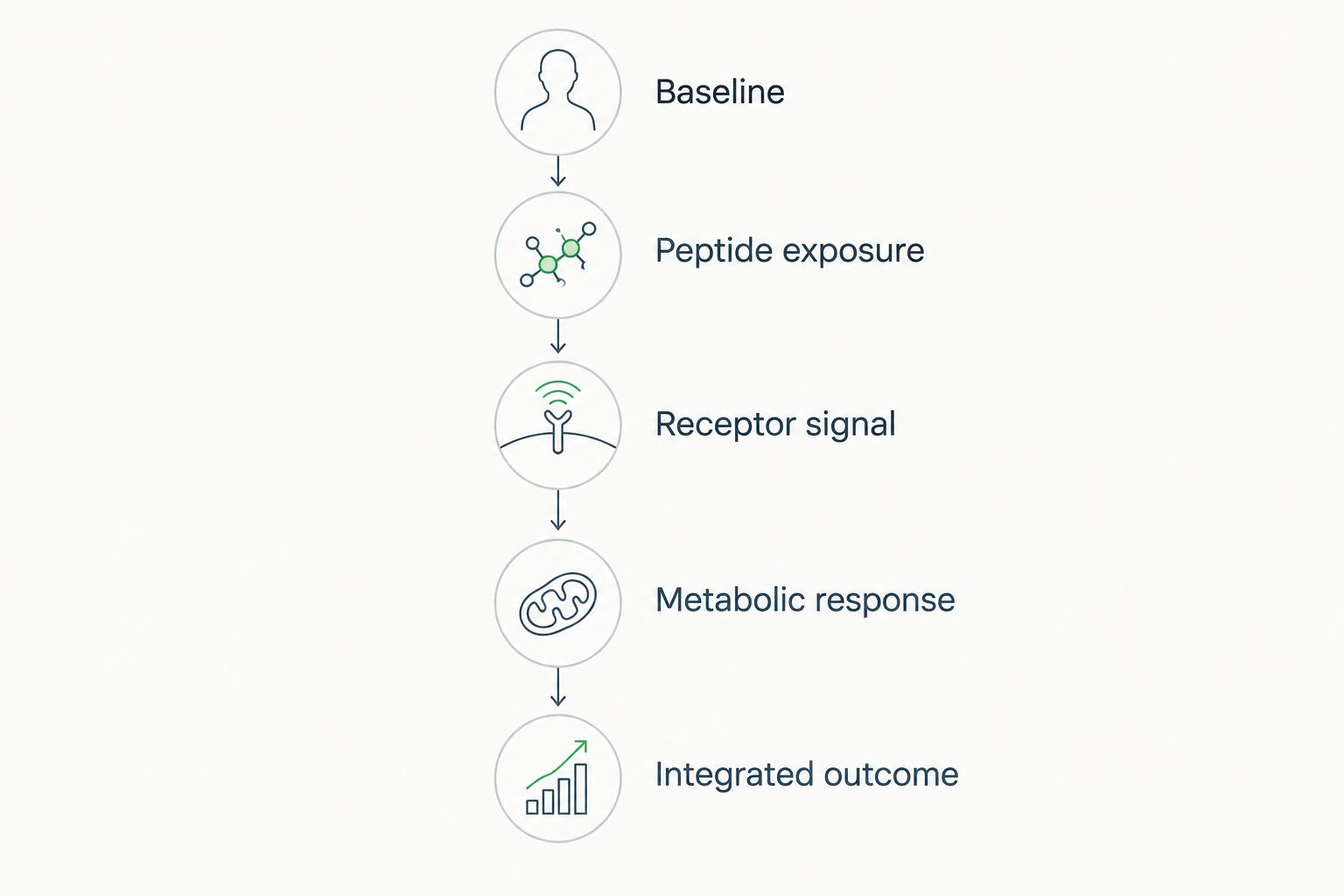
Peptide concentration measured by LC-MS/MS is therefore not a pharmacodynamic result by itself. It becomes more informative when aligned with cAMP signaling, insulin or C-peptide release, glucagon suppression, glucose response, or another mechanism-linked readout.
- Use intact peptide concentration to establish exposure rather than receptor activity
- Use cAMP or another validated functional signal for proximal GLP-1R activation
- Use insulin, C-peptide, glucagon, and glucose as downstream metabolic markers where the model supports them
- Treat body weight, food intake, and tissue changes as integrated outcomes rather than direct receptor-engagement markers
- Plot exposure and response on the same time axis without treating them as interchangeable
Match each marker to a fit-for-purpose assay
An assay is fit for purpose when its selectivity, sensitivity, precision, matrix performance, and reportable range support the study question. A method validated for plasma insulin cannot automatically be applied to cell-culture media or tissue homogenate.
Functional cell assays are useful for receptor signaling. Immunoassays support higher-throughput hormone measurements but require cross-reactivity and matrix checks. LC-MS/MS can distinguish intact peptide, related species, or metabolites when the method has suitable standards and recovery.
For GLP-1 pharmacodynamic biomarker studies, GLP-123 enters only after the lab defines compound identity, purity documentation, storage requirements, and assay compatibility. The site's ecommerce role does not make a supplied peptide an analytical reference standard.
- Review the matrix, expected concentration range, and interference risks before choosing a platform
- Confirm whether an immunoassay recognizes intact analyte, metabolites, or structurally related peptides
- Use calibration standards and quality controls that match the analytical method
- Establish dilution integrity when samples can exceed the assay range
- Use GLP-1 bioanalytical methods to separate exposure measurement from functional response testing
Set sampling around the compound and response
Sampling times must reflect both the compound's exposure profile and the expected response delay. Native GLP-1 is rapidly degraded by DPP-4 and has a circulating half-life of roughly 1-2 minutes. FDA prescribing information available in 2026 describes semaglutide as having an elimination half-life of approximately 1 week, or about 7 days.
Those values do not justify one fixed schedule. A cell-based signaling assay can require early measurements, while a long-acting analog study needs observations that capture sustained exposure and delayed downstream effects.
In adult clinical research, a conventional oral glucose tolerance test uses a 75 g glucose load and includes a 2-hour value. That convention is relevant to its specific setting and should not be copied into cell or animal work without model-specific justification.
- Collect a pre-exposure baseline for every biomarker used in change-from-baseline analysis
- Place early samples around expected receptor signaling and later samples around downstream response
- Use the same dose-relative timing across comparable groups
- Record collection, processing, and storage timestamps for every sample
- Flag samples outside the permitted window before statistical analysis
- Add vehicle and positive controls at timepoints that support direct comparison
Establish controls and acceptance criteria
Controls determine whether a flat biomarker curve means the compound lacked activity or the assay failed. At minimum, the design needs a vehicle or negative control, appropriate assay quality controls, and a positive control when a validated comparator exists.
Acceptance criteria belong in the protocol before results are visible. Define calibration performance, quality-control recovery, replicate agreement, sample stability, and rules for repeat analysis. Use method-specific limits supported by validation data rather than copying arbitrary percentages from an unrelated assay.
- Include vehicle controls to quantify model and handling effects
- Use positive controls only when their expected response is established in the chosen model
- Run calibration standards and quality controls with each analytical batch
- Predefine rules for failed controls, repeat analysis, and sample exclusion
- Track reagent lots, reference materials, plates, analysts, and instrument runs
- Preserve raw output and audit trails with the summarized 2026 dataset
Normalize the biological context
GLP-1 responses depend on glucose concentration, feeding state, model characteristics, tissue, and prior exposure. A stronger insulin signal under high-glucose conditions does not carry the same meaning as the same signal under basal conditions.
Normalization should preserve biology rather than hide variation. Expressing results against baseline, cell count, protein content, viable cell number, or vehicle response can be appropriate, but the denominator must match the assay and remain consistent across groups.
- Record glucose concentration or challenge conditions alongside insulin and C-peptide results
- Standardize fasting or feeding conditions when the model and approved protocol require it
- Report model, tissue, matrix, passage, and viability information relevant to interpretation
- Use one predefined normalization method for comparable groups
- Show normalized and underlying measurements when normalization can obscure absolute change
- Analyze sex, age, or model differences only when the study was designed to support those comparisons
Analyze the full time course
A single peak value can miss delayed effects, rebound behavior, tolerance, or a disconnect between exposure and response. Time-course analysis shows whether a biomarker changes before, with, or after the measured outcome.
Compare baseline, response magnitude, time to observed peak, duration, and recovery using the statistical plan specified before analysis. Do not interpret every difference as GLP-1R-specific when the design lacks receptor-selective controls.
- Plot individual observations as well as group summaries
- Align pharmacokinetic and pharmacodynamic measurements by subject, sample, and timepoint
- Report missing samples and protocol deviations instead of silently removing them
- Distinguish prespecified analyses from exploratory findings
- Examine dose-response and concentration-response relationships separately
- Confirm unexpected findings with an orthogonal assay or independent experiment
Compare measurement options for research teams
No single platform measures the full GLP-1 response. GLP-123 does not change that analytical decision: research peptide sourcing and pharmacodynamic measurement are separate functions.
| Option | Best for | Main advantage | Key limitation |
|---|---|---|---|
| Functional cAMP or reporter assay | Proximal GLP-1R activation in cell models | Measures receptor-linked signaling directly | In vitro activity does not represent the full systemic response |
| Immunoassay | Insulin, C-peptide, glucagon, or related protein markers | Supports efficient analysis across many samples | Cross-reactivity and matrix effects require verification |
| LC-MS/MS | Intact peptide exposure, metabolites, and analytically distinct species | Offers molecular selectivity when the method is validated | Exposure is not the same as pharmacodynamic response |
| Glucose challenge with hormone sampling | Integrated glucose-dependent metabolic response | Connects glucose, insulin, C-peptide, and glucagon over time | Several physiological pathways influence the result |
| Gastric-emptying assessment | Studies focused on gastrointestinal pharmacodynamics | Measures a recognized downstream GLP-1 effect | Method choice and indirect proxies can affect interpretation |
| Qualified CRO service | Teams without validated internal methods | Provides specialist instruments and documented workflows | The sponsor has less direct control over scheduling and method changes |
Best overall approach: combine a proximal functional assay with at least one downstream biomarker and a matched exposure measurement. A functional assay alone lacks systemic context, while glucose or insulin alone cannot prove receptor engagement.
Common mistakes research teams make
- Calling peptide concentration a PD biomarker. Concentration is a pharmacokinetic measurement unless the study establishes it as a validated surrogate for biological response.
- Using insulin as the only downstream marker. Insulin depends on glucose context and does not independently establish GLP-1R engagement. Pair it with glucose, C-peptide, glucagon, or a proximal signal as the research question requires.
- Copying sampling times between analogs. A molecule cleared within minutes and an analog persisting for about 7 days cannot be interpreted with the same time grid.
- Changing matrices or assay kits during a study. The resulting method difference can resemble a biological shift. A bridging assessment is required before combining results.
- Treating a certificate of analysis as assay validation. Identity and purity documentation describe the material; they do not establish performance in a receptor or biomarker assay.
- Ignoring repeated-exposure effects. Receptor desensitization, adaptation, or altered downstream response can change the relationship between exposure and effect.
- Writing acceptance criteria after seeing results. That turns quality control into result selection and weakens the 2026 dataset.
FAQ
What are GLP-1 pharmacodynamic biomarkers?
GLP-1 pharmacodynamic biomarkers are measurable indicators of receptor engagement or downstream biological response to a GLP-1-active compound. Examples include cAMP signaling, insulin or C-peptide release, glucagon suppression, glucose response, and gastric-emptying measures when they match the study model.
What is the best single biomarker for GLP-1 research?
There is no universal single best GLP-1 biomarker. The strongest design pairs a proximal receptor-linked signal with a downstream response and an exposure measurement selected for the specific model.
Is insulin enough for a GLP-1 pharmacodynamic study?
Insulin alone is not enough to establish GLP-1R engagement. Its interpretation depends on glucose conditions, baseline secretion, model characteristics, and supporting measurements such as C-peptide, glucagon, or receptor signaling.
How are pharmacodynamic biomarkers different from pharmacokinetic measurements?
Pharmacodynamic biomarkers measure biological response, while pharmacokinetic measurements describe compound exposure and clearance. Intact peptide concentration can support exposure-response analysis but does not directly prove receptor activation.
When should samples be collected in a GLP-1 study?
Samples should be collected around the compound’s exposure profile and the expected timing of each biological response. Native GLP-1 lasts roughly 1-2 minutes in circulation, while semaglutide has an elimination half-life of about 7 days.
Can gastric emptying be used as a GLP-1 biomarker?
Gastric emptying can serve as a downstream pharmacodynamic measure when gastrointestinal response is part of the research question. The protocol must specify whether the method measures emptying directly or uses an indirect proxy.
Does a certificate of analysis validate a GLP-1 assay?
No, a certificate of analysis does not validate a pharmacodynamic assay. It can document attributes of the supplied material, while assay validation separately addresses selectivity, precision, range, recovery, stability, and matrix effects.
What should a 2026 GLP-1 biomarker report include?
A 2026 report should identify the model, matrix, compound, sampling schedule, assay method, controls, acceptance criteria, normalization approach, deviations, and statistical plan. It should present pharmacokinetic, pharmacodynamic, and outcome measurements as related but distinct evidence.
One last thing
The most useful GLP-1 pharmacodynamic biomarker is not necessarily the one with the largest change. It is the one positioned closest to the mechanism while remaining measurable, reproducible, and interpretable in the selected model.
For a GLP-123 research peptide project in 2026, finish the biomarker map before sourcing: mechanism, matrix, assay, timepoints, controls, and acceptance criteria. That order prevents the available material from dictating a study design it cannot support.
Related guides
Originally published on glp-123.com. This library mirrors the guide for easier reading. Products mentioned are for laboratory research only.
View original


