
GLP-1 beta-cell signaling research examines how receptor activation triggers cAMP-dependent signaling that potentiates insulin secretion when glucose is elevated. Reproducible studies use a validated cell model, matched glucose controls, and peptide lots with checked analytical documentation.
Key points
- GLP-1 beta-cell signaling research studies how receptor activation drives cAMP-dependent, glucose-conditioned insulin secretion.
- INS-1 832/13 and MIN6 lines dominate published beta-cell signaling assays; primary islets remain the reference standard.
- Peptide purity and lot variability get misread as biological signal when CoA data isn’t checked first.
- Glp-123’s research peptide catalog publishes batch-level documentation researchers can cross-check against protocol requirements.
Preclinical researchers studying GLP-1 beta-cell signaling need a defined endpoint, a validated cell model, and a peptide source with verifiable analytical data before the first assay plate goes into the incubator. This guide walks through the setup decisions that turn a GLP-1 beta cell signaling study into data another lab can reproduce in 2026.
- GLP-1 beta-cell signaling research studies how receptor activation drives cAMP-dependent, glucose-conditioned insulin secretion.
- INS-1 832/13 and MIN6 lines dominate published beta-cell signaling assays; primary islets remain the reference standard.
- Peptide purity and lot variability get misread as biological signal when CoA data isn’t checked first.
- Glp-123’s research peptide catalog publishes batch-level documentation researchers can cross-check against protocol requirements.
- Reproducible glp-1 beta cell signaling data in 2026 pairs a validated cell model with an analytically documented peptide lot.
Why GLP-1 beta-cell signaling research matters for lab teams
GLP-1 receptor is a class B G-protein-coupled receptor expressed on pancreatic beta cells, and its activation triggers a Gs-adenylate cyclase-cAMP cascade that potentiates insulin secretion only when glucose is already elevated. That glucose-dependence is the whole reason the receptor is studied for metabolic research: it doesn't just make cells secrete insulin, it changes how they respond to glucose.
For a lab running dose-response or mechanism studies, that means the assay design matters more than the peptide dose. A pancreatic islet research protocol that skips glucose controls will produce a signal, but it won't tell you whether that signal came from the peptide or from the glucose load itself. Glp-123's research peptide catalog exists for labs that need that distinction to hold up under peer review.
Setting up a GLP-1 beta-cell signaling protocol
1. Define the signaling endpoint before you pick a model
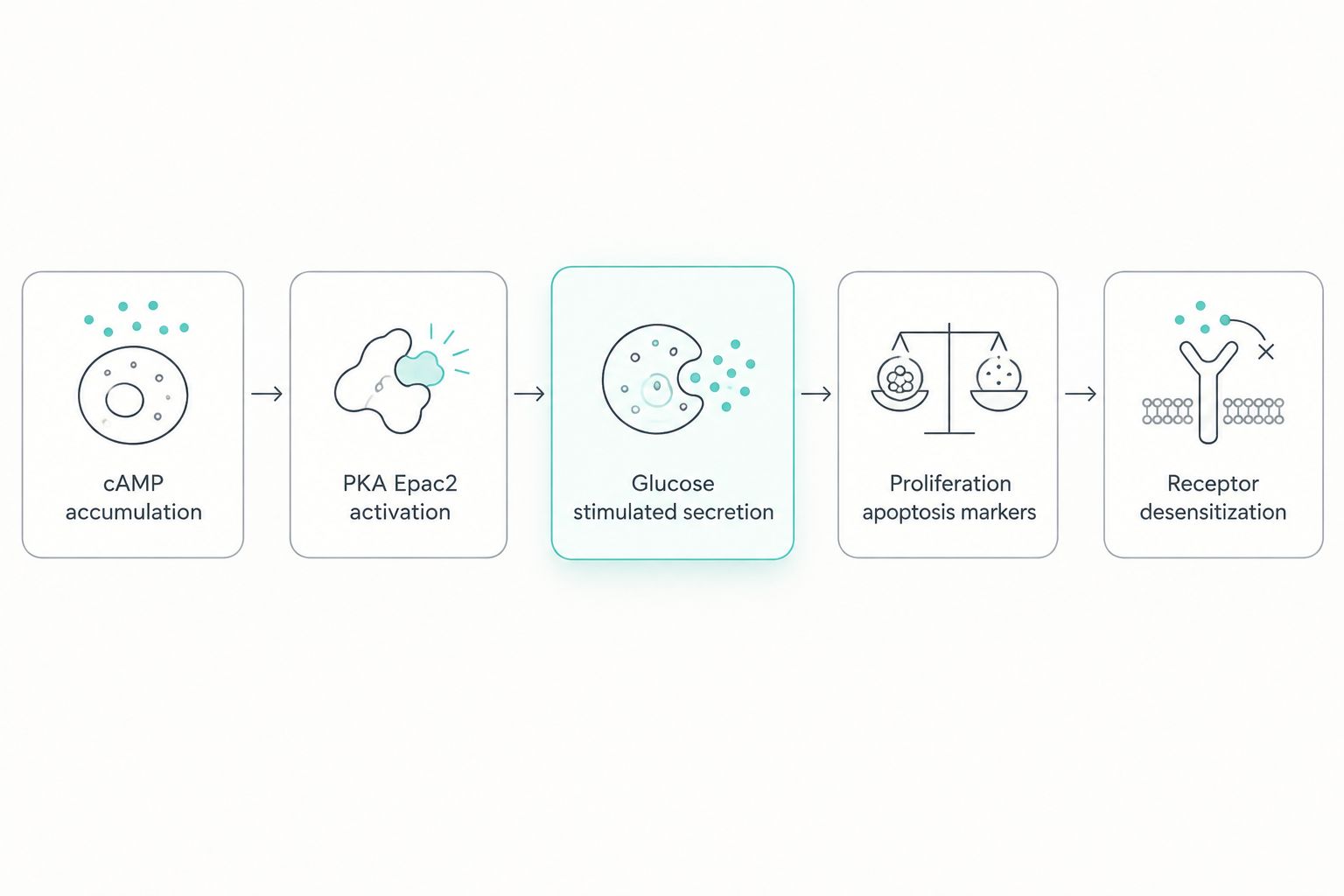
Decide what you're measuring before you order cells or peptide. The endpoint dictates the assay format, the readout window, and which controls are non-negotiable.
- cAMP accumulation, measured by ELISA or a BRET biosensor
- PKA and Epac2 activation markers downstream of cAMP
- Static or dynamic glucose-stimulated insulin secretion (GSIS)
- Proliferation and apoptosis markers (Ki67, TUNEL) for chronic-exposure studies
- Receptor internalization and desensitization kinetics for repeat-dose protocols
2. Choose a validated beta-cell model
The model determines how far your results generalize. Immortalized lines are cheap and scalable; primary tissue is closer to physiology but harder to standardize.
- INS-1 832/13 for high-throughput dose-response work
- MIN6 for cAMP and calcium-flux signaling assays
- Primary rodent islets for physiologically relevant GSIS
- Human islet preparations for translational beta-cell signaling studies
- EndoC-βH1 for long-term human beta-cell line studies
3. Match the receptor assay format to your throughput needs
A 384-well biosensor plate and a radioligand binding assay answer different questions at different costs in time and hands-on labor.
- Label-free biosensor for real-time receptor activation kinetics
- cAMP ELISA for endpoint quantification across large plate counts
- Radioligand binding for receptor affinity and competition studies
- Calcium flux imaging for downstream signaling confirmation
- 384-well format when screening multiple peptide analogs at once
4. Control peptide purity and stability before dosing
A dose-response curve that doesn't flatten or shift predictably is often a peptide quality problem, not a biology problem. Glp-123 attaches a certificate of analysis to each research peptide lot so labs can rule this out before troubleshooting the assay itself.
- Request HPLC purity data on the specific lot you're dosing
- Check endotoxin testing results before cell-based work
- Confirm the reconstitution solvent matches your protocol
- Avoid repeat freeze-thaw cycles on the same aliquot
- Verify storage temperature history, ideally -20°C for lyophilized stock
5. Standardize reconstitution and handling across replicates
Inconsistent reconstitution technique introduces more variance into a beta-cell signaling assay than most researchers budget for.
A gloved researcher drawing bacteriostatic water into a syringe next to a lyophilized peptide vial on a stainless lab bench sets the tone for every replicate that follows.

- Use the same bacteriostatic water volume across every prep
- Aliquot into single-use vials instead of repeat-dosing one vial
- Store reconstituted peptide at -20°C between uses
- Mix by gentle swirling, never vortexing
- Log the reconstitution date on every vial
6. Build glucose concentration controls into every GSIS assay
GLP-1 receptor signaling only potentiates insulin secretion above baseline glucose. Skip the glucose gradient and you can't tell whether the peptide did anything at all.
- Low glucose baseline, typically around 2.8 mM
- High glucose stimulation, typically around 16.7 mM
- A full dose-response curve for the glucose-dependent insulin secretion endpoint
- A positive control agonist run in parallel
- A vehicle-only control on every plate
“If you don’t control glucose concentration, you’re not measuring GLP-1 signaling, you’re measuring glucose.”
7. Document batch and assay data for reproducibility
A result nobody else can reproduce isn't a result. Documentation is the cheapest fix available.
- Log the peptide lot number on every data file
- Record passage number of the cell line used
- Archive raw plate reads, not just summary statistics
- Register the assay SOP version alongside the dataset
- Store the CoA file with the raw data, not in a separate folder
Comparing beta-cell models for GLP-1 signaling research
| Model | Best for | Key limitation |
|---|---|---|
| INS-1 832/13 | High-throughput dose-response screening | Insulin content drifts with passage number |
| MIN6 | cAMP and calcium signaling assays | Glucose responsiveness declines at high passage |
| Primary rodent islets | Physiologically relevant GSIS | Donor variability, limited yield per isolation |
| Human islet preparations | Translational GLP-1 beta-cell signaling work | Scarce supply, short viable window |
| EndoC-βH1 | Long-term human beta-cell line studies | Requires specialized culture matrix |
Verdict: INS-1 832/13 wins on throughput for early screening; primary or human islets are the only defensible choice once a finding needs to hold up in a manuscript.
Common mistakes in GLP-1 beta-cell signaling research
- Treating INS-1 832/13 data as interchangeable with primary islet data without adjusting for passage-dependent insulin content drift.
- Running GSIS assays without matched glucose controls, which makes it impossible to separate peptide signal from glucose alone.
- Skipping CoA review on a new peptide lot, then spending weeks troubleshooting an assay that was never the problem.
- Repeat freeze-thawing the same reconstituted vial, degrading receptor-binding activity between replicate runs.
- Ignoring receptor desensitization kinetics in prolonged-exposure protocols, then reporting reduced signaling as reduced potency.
FAQ
What is GLP-1 beta-cell signaling?
GLP-1 beta-cell signaling is the cAMP-dependent cascade triggered when GLP-1 binds its receptor on pancreatic beta cells, which potentiates insulin secretion specifically when glucose is already elevated.
Which cell model is best for GLP-1 beta-cell signaling research?
INS-1 832/13 is best for high-throughput screening, MIN6 for cAMP and calcium assays, and primary or human islets for translational studies published in 2026.
Why do glucose-dependent insulin secretion assays need a glucose gradient?
GLP-1 receptor signaling only potentiates insulin secretion above baseline glucose, so a low-glucose and high-glucose condition are both required to isolate the peptide effect from glucose alone.
How does peptide purity affect beta-cell signaling assay results?
Impure or degraded peptide produces flattened or inconsistent dose-response curves that get misread as biological variability instead of a quality issue.
What storage conditions keep GLP-1 research peptides stable?
Lyophilized GLP-1 peptides are typically stored at -20°C, with reconstituted aliquots used once and not subjected to repeat freeze-thaw cycles.
Is MIN6 or INS-1 832/13 better for cAMP signaling assays?
MIN6 is more commonly used for cAMP and calcium-flux signaling work, while INS-1 832/13 is favored for high-throughput dose-response screening.
What documentation should accompany a research peptide lot?
A certificate of analysis with HPLC purity data and endotoxin testing results should accompany every peptide lot used in beta-cell signaling research.
Can human islet preparations be used for routine GLP-1 signaling screening?
Human islet preparations are better reserved for confirmatory or translational studies since supply is scarce and the viable window after isolation is short.
One last thing
The detail most labs skip is that GLP-1 receptor signaling is conditional, not constant: dose a beta-cell model at fasting glucose levels and the cAMP response barely moves, no matter how clean the peptide is. Glp-123 built its research peptide catalog around that reality — CoA data travels with every lot precisely because glucose-dependent assays punish undocumented peptide quality faster than almost any other endpoint in metabolic research.
Related guides
- Beta-cell proliferation research
- GLP-1 insulin secretion research
- GLP-1 systematic review 2026
Originally published on glp-123.com. This library mirrors the guide for easier reading. Products mentioned are for laboratory research only.
View original


