
The best storage condition for reconstituted GLP-1 peptides is formulation-specific, monitored cold storage, chosen by measured stability rather than the coldest temperature alone. Validated refrigeration suits routine access to working samples within a solution-specific holding period, and frozen aliquots suit reserve samples only after freeze-thaw performance has been evaluated.
Key points
- The best storage conditions for reconstituted GLP-1 peptides depend on formulation, container compatibility, and measured stability.
- Refrigeration supports routine assay access only when the specific solution has a validated holding period.
- Frozen aliquots suit reserve samples only after freezing and thawing have been evaluated.
- GLP-123 peptide storage guidance concerns laboratory research, not therapeutic applications.
Best overall: formulation-specific, monitored cold storage. Best for routine assay access: validated refrigeration. Best for reserve samples: validated frozen aliquots. This 2026 guide ranks the best storage conditions for reconstituted GLP-1 peptides by preservation of chemical integrity and in vitro activity—not by the coldest temperature alone.
- The best storage conditions for reconstituted GLP-1 peptides depend on formulation, container compatibility, and measured stability.
- Refrigeration supports routine assay access only when the specific solution has a validated holding period.
- Frozen aliquots suit reserve samples only after freezing and thawing have been evaluated.
- GLP-123 peptide storage guidance concerns laboratory research, not therapeutic applications.
Why this matters
Storage changes the material entering an experiment. Chemical degradation, aggregation, or adsorption to a container can alter the effective peptide concentration even when a solution remains clear. Protein stability literature distinguishes these processes because each requires different analytical evidence.[^1][^2]
For GLP-123 research peptides, the strongest storage recommendation is the condition supported by formulation-specific stability data. A batch Certificate of Analysis describes the tested material; it does not automatically establish how a newly prepared solution behaves during storage.
The distinction between initial quality and storage performance is central to GLP-1 peptide stability research. In 2026, a useful laboratory record connects peptide identity, solution composition, container, temperature history, and assay results.
What makes the best GLP-1 peptide storage condition?
A storage ranking needs criteria before temperature recommendations. These five criteria apply to research solutions rather than finished pharmaceutical formulations:
- Chemical integrity: A suitable analytical method distinguishes intact peptide from relevant degradation products.
- Physical stability: The condition limits aggregation, precipitation, and losses associated with surfaces.
- Functional retention: Stored material retains the response required for the intended in vitro assay.
- Handling consistency: Routine access does not introduce uncontrolled warming, agitation, or repeated freezing and thawing.
- Traceable evidence: The documented condition matches the actual peptide, formulation, container, and holding period.
No single result satisfies every criterion. A chromatographic purity profile addresses a different question from receptor activation, while visual inspection cannot establish either one.
The best storage condition preserves the property the experiment measures, not merely the appearance of the solution.
Storage options at a glance
These are ranked research strategies, not interchangeable prescriptions. Refrigeration at 2–8°C and freezing at −20°C or −80°C are familiar laboratory temperature categories; none establishes a GLP-1 peptide shelf life without supporting measurements.
| Rank | Storage strategy | Best for | Standout feature | Key limitation |
|---|---|---|---|---|
| 1 | Validated refrigeration | Routine access to working samples | Avoids freezing and thawing during ordinary access | Requires a solution-specific holding period |
| 2 | Validated frozen aliquots | Reserve samples and separated experimental runs | Separates reserve material from frequently accessed material | Freezing can change solution chemistry and physical stability |
| 3 | Controlled assay-temperature exposure | Material actively used in an assay | Matches the immediate experimental environment | Does not establish a condition for extended storage |
The ranking reflects handling roles. Validated frozen storage takes precedence over refrigeration when the particular formulation performs better under that condition.
1. Validated refrigeration: best for routine assay access
Refrigeration is a practical candidate for working solutions that require repeated access. It avoids the freezing and thawing associated with retrieving a frozen reserve. However, reduced temperature does not eliminate chemical reactions, aggregation, or container-related losses.[^1][^2]
A 2–8°C range describes a refrigerated environment, not a proven storage specification for every GLP-1 peptide. The relevant evidence must cover the same solution composition, container, and holding period used in the laboratory.
Validated refrigeration pros:
- Supports access without a freeze–thaw event.
- Allows temperature history to be monitored and recorded.
- Separates routine working material from reserve samples.
Validated refrigeration cons:
- A general refrigerator setting does not prove sample stability.
- Repeated access introduces temperature excursions and handling variation.
- A clear solution can still contain chemical changes or reduced peptide recovery.
Best for: Working samples with documented refrigerated stability over the intended experimental period.
Temperature excursions deserve their own record. Time outside controlled storage is part of the sample's history, not an interruption that disappears when the vial returns to the refrigerator. The discussion of GLP-1 cold-chain stability addresses that distinction.
Verdict: Hold refrigerated working samples only within the condition and period supported by the laboratory's evidence.
2. Validated frozen aliquots: best for reserve samples
Frozen aliquots separate reserve material from samples accessed during routine experiments. Their value comes from reducing repeated handling of the reserve, not from a guarantee that freezing preserves every peptide solution.
Freezing changes the physical environment. Ice formation concentrates dissolved components in the remaining liquid phase, and some buffers undergo pH shifts during freezing. Interfaces and thawing conditions also affect protein stability; these mechanisms are reviewed in the formulation literature.[^3]
A −20°C freezer and a −80°C freezer therefore represent different candidate conditions. Neither earns a universal recommendation based solely on its setpoint. The 2026 decision should follow analytical recovery and functional performance after the intended storage and thawing history.
Validated frozen aliquots pros:
- Separate reserve samples from frequently accessed working material.
- Allow each sample's freezing and thawing history to be tracked.
- Support comparisons between stored material and a suitable baseline.
Validated frozen aliquots cons:
- Freezing can introduce stresses absent from refrigerated storage.
- Smaller portions do not eliminate surface adsorption or container incompatibility.
- A nominal freezer temperature does not establish post-thaw integrity.
Best for: Reserve samples with demonstrated recovery and assay performance after frozen storage.
A frozen sample needs acceptance criteria beyond looking clear after thawing. Relevant measurements include intact-peptide recovery, degradation profiles, and the functional endpoint required by the experiment. Those results must correspond to the actual formulation rather than a different peptide preparation.
Verdict: Wait for formulation-specific freeze–thaw evidence before treating frozen storage as the default.
3. Controlled assay-temperature exposure: best for active experiments
Material actively participating in an in vitro assay must experience the assay's defined environment. This is controlled experimental exposure, not a general recommendation to store reconstituted peptide on the bench.
The distinction matters because a peptide stock and an assay mixture are different materials. Dilution, buffer composition, medium components, and contact surfaces can change peptide recovery or activity. Stability evidence for the stock cannot automatically establish stability in the assay mixture.
Controlled assay-temperature exposure pros:
- Matches the conditions under which the experimental response is measured.
- Makes exposure time part of the recorded assay design.
- Supports comparisons between initial and end-of-assay material.
Controlled assay-temperature exposure cons:
- Does not justify extended ambient storage.
- Adds a different formulation and surface environment from the stock solution.
- Requires controls to distinguish storage effects from assay variation.
Best for: Samples already committed to a defined in vitro experiment.
For 2026 laboratory protocols, the meaningful question is whether the material remains suitable throughout the experiment. A broad statement that a peptide is stable at room temperature is inadequate without composition, duration, and analytical scope.
Verdict: Skip uncontrolled bench storage; retain only the exposure defined by the assay.
How these storage strategies were ranked
The ranking prioritizes documented integrity, functional retention, and control of handling history. Refrigeration occupies the routine-access role, frozen aliquots occupy the reserve role, and assay-temperature exposure occupies the active-experiment role.
This is a role-based comparison, not a shelf-life study. General protein formulation literature explains why these conditions require evaluation, but it does not establish a storage period for an unspecified reconstituted GLP-1 peptide.[^1][^2][^3]
Why formulation and containers change the answer
A peptide name alone does not define a storage system. Solution composition, molar concentration, container material, and closure all form part of the condition being evaluated. Changing one of them changes the scope of the supporting evidence.
Three mechanisms deserve separate attention:
- Chemical change: Covalent modification or cleavage changes the molecular species present.
- Aggregation: Peptide molecules associate into larger structures, with or without visible particles.
- Surface loss: Peptide associates with container or handling surfaces, reducing recovery from the liquid phase.
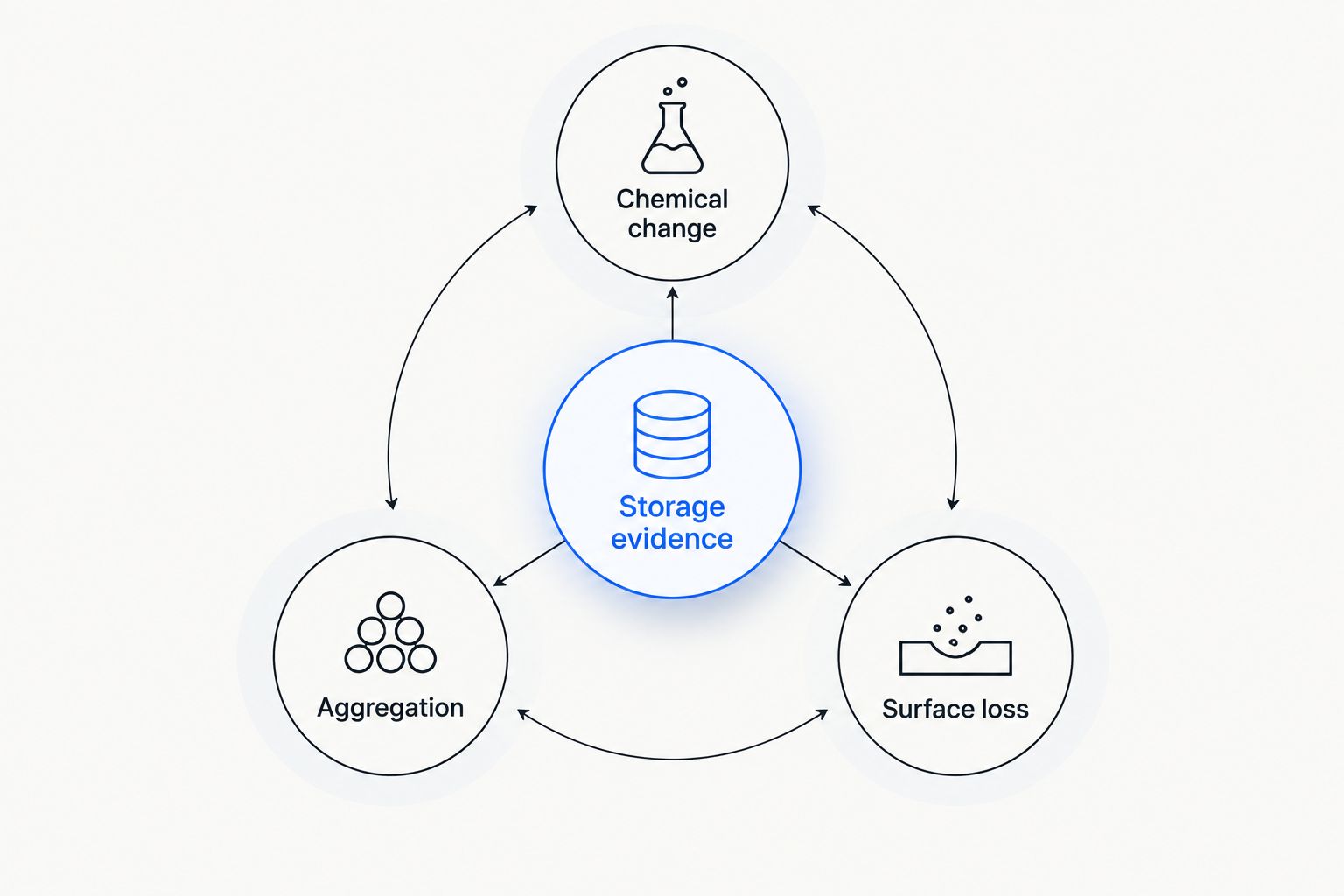
Container choice is therefore an analytical question. Glass and plastic each require compatibility evidence for the actual solution; neither material is universally best for all peptide formulations. Replacing a container while retaining an old holding period creates an untested combination.
Light exposure also belongs in the storage description. Light-induced degradation is a recognized formulation concern, but the sensitivity of a particular peptide preparation must be established rather than assumed.[^2]
What a defensible storage record contains
A useful 2026 storage record connects the material to the evidence. It includes peptide identity and batch, solution composition, molar concentration, container and closure, temperature history, access events, and the intended analytical or functional endpoint.
The baseline matters. Without a suitable initial measurement, a later purity result cannot by itself establish how much material changed during storage. Likewise, a reduced receptor response cannot identify whether the cause was degradation, adsorption, aggregation, or assay variation.
Different methods answer different questions:
- Chromatographic analysis: Separates relevant chemical species when the method has adequate specificity.
- Mass spectrometry: Helps investigate molecular identity and selected chemical changes.
- Physical characterization: Evaluates aggregation or particles within the method's measurement range.
- Functional assays: Assess the response relevant to the experimental objective.
These methods complement rather than replace one another. A purity percentage is not the same as recovered peptide concentration, and receptor activation is not a direct measurement of purity.
GLP-123 emphasizes batch-specific Certificates of Analysis in its research-peptide documentation. That documentation provides a starting point for material assessment; post-preparation storage still requires evidence matched to the resulting solution.
Which storage condition should a laboratory choose?
For reconstituted GLP-1 peptides, choose the documented condition that preserves both analytical integrity and the required in vitro response. Validated refrigeration fits routine access; validated frozen aliquots fit reserve material. Uncontrolled ambient holding has no place in the default storage plan.
When supporting evidence is absent, neither the coldest freezer nor a familiar refrigerator range resolves the uncertainty. The defensible next step is a stability evaluation with defined acceptance criteria—not an invented expiry date.
In 2026, the most useful storage instruction is specific enough to reproduce. It identifies the material, formulation, container, temperature, permitted holding period, and measurements supporting that period.
FAQ
What are the best storage conditions for reconstituted GLP-1 peptides?
The best storage conditions are those supported by stability data for the specific peptide solution and container. Validated refrigeration fits routine access, while validated frozen aliquots fit reserve samples.
Is refrigeration better than freezing for GLP-1 research peptides?
Neither refrigeration nor freezing is universally better. Refrigeration avoids freeze–thaw stress, while frozen storage requires evidence that the formulation retains integrity and functional performance after thawing.
Can every reconstituted GLP-1 peptide be stored at 2–8°C?
A 2–8°C range is not a universal storage specification for reconstituted GLP-1 peptides. Its suitability and holding period must be established for the actual formulation and container.
Does −80°C storage guarantee peptide stability?
No, −80°C storage does not guarantee peptide stability. Freezing changes the solution environment, so post-thaw recovery and relevant assay performance still require evaluation.
How long does a reconstituted GLP-1 research peptide remain stable?
There is no single holding period for all reconstituted GLP-1 research peptides. A defensible period requires measurements covering the specified formulation, container, temperature, and handling history.
Does a clear peptide solution prove that storage was suitable?
No, clear appearance does not prove chemical integrity or retained activity. Chemical changes and surface losses can occur without visible cloudiness.
Does a Certificate of Analysis establish stability after preparation?
A Certificate of Analysis does not establish stability after preparation unless it explicitly includes applicable solution-stability evidence. Batch-release results and post-preparation holding data answer different questions.
One last thing
A high purity result can coexist with poor recovery. If intact peptide leaves the liquid phase by associating with a surface, the remaining liquid can still show a high proportion of intact peptide among the species measured.
Storage evaluation needs both a chemical profile and a recovery question. That distinction prevents an attractive purity number from concealing a weaker experimental reagent.
Related guides
- GLP-1 impurity characterization for research
- Glass versus plastic vials for peptide research storage
- How to study GLP-1 receptor binding in the lab
[^1]: Wang W. Protein stability and formulation. International Journal of Pharmaceutics. 2000;203:1–60. Review of physical and chemical instability in protein formulations; not a GLP-1 solution shelf-life study.
[^2]: Manning MC, Chou DK, Murphy BM, Payne RW, Katayama DS. Stability of protein pharmaceuticals: an update. Pharmaceutical Research. 2010;27:544–575. Review of degradation mechanisms and formulation factors; not a batch-specific storage specification.
[^3]: Bhatnagar BS, Bogner RH, Pikal MJ. Protein stability during freezing: separation of stresses and mechanisms of protein stabilization. Pharmaceutical Development and Technology. 2007;12:505–523. Review of freezing-related stresses in protein formulations; not proof of frozen stability for every GLP-1 peptide.
All products available on glp-123.com are supplied strictly for laboratory research and development purposes only. These materials are not intended for human or animal consumption, medical use, diagnostic procedures, or therapeutic applications. Any ancillary items included with a product, such as Bacteriostatic Water or mixing syringes, are provided solely as research-use accessories to support laboratory preparation and reconstitution procedures. Syringes are not intended for injection, administration, or use involving humans or animals. The statements and content on this website have not been evaluated by the U.S. Food and Drug Administration (FDA). The products offered are not designed to diagnose, treat, cure, or prevent any disease or medical condition. GLP-123 operates solely as a chemical supplier for research professionals and accredited institutions and is not a pharmacy, compounding facility, or outsourcing establishment under Sections 503A or 503B of the Federal Food, Drug, and Cosmetic Act. By purchasing from GLP-123, you confirm that all products will be used in compliance with applicable laws and laboratory safety guidelines.
Originally published on glp-123.com. This library mirrors the guide for easier reading. Products mentioned are for laboratory research only.
View original


