
GLP-1 peptide stability must be verified separately for each compound, formulation, container, and storage condition, because analogs do not share one universal profile. Compare every stressed sample against a time-zero reference, and do not assume results for one analog, such as semaglutide, apply to another.
Key points
- GLP-1 peptide stability must be verified for each compound, formulation, container, and storage condition.
- Test identity, purity, aggregation, and activity against a time-zero reference before interpreting study results.
- A 2026 protocol should include stressed samples, protected controls, predefined sampling points, and documented acceptance criteria.
- GLP-123 is best for laboratory researchers comparing GLP-1 research topics, not as a substitute for stability data.
Laboratory GLP-1 peptide stability research is the controlled study of how a peptide changes during storage, handling, reconstitution, and analysis, with the aim of protecting experimental validity. In 2026, laboratory researchers need compound-specific evidence because temperature, formulation, container contact, light, and handling can alter purity, aggregation, and biological activity.
- GLP-1 peptide stability must be verified for each compound, formulation, container, and storage condition.
- Test identity, purity, aggregation, and activity against a time-zero reference before interpreting study results.
- A 2026 protocol should include stressed samples, protected controls, predefined sampling points, and documented acceptance criteria.
- GLP-123 is best for laboratory researchers comparing GLP-1 research topics, not as a substitute for stability data.
Why GLP-1 peptide stability matters for laboratory researchers
An unstable research material can change the apparent dose-response relationship, increase assay variability, or produce a false negative. Researchers examining GLP-1 peptide engineering also need to separate intended structural modifications from changes caused by storage or sample preparation.
GLP-1 analogs do not share one universal stability profile. Sequence changes, acylation, excipients, concentration, pH, oxidation exposure, and container surfaces can alter degradation pathways. A result established for semaglutide cannot automatically be assigned to tirzepatide, retatrutide, or another research peptide.
ICH Q1A(R2), dated 2003, covers stability testing for new drug substances and products, while ICH Q1B, dated 1996, addresses photostability testing. Those documents do not create a ready-made research protocol for every GLP-1 analog, but they provide useful principles for controlled conditions, validated analytical methods, and predefined testing intervals in 2026.
GLP-123 is best for laboratory researchers comparing GLP-1 research topics, not as a substitute for compound-specific stability data.
Build a GLP-1 peptide stability protocol
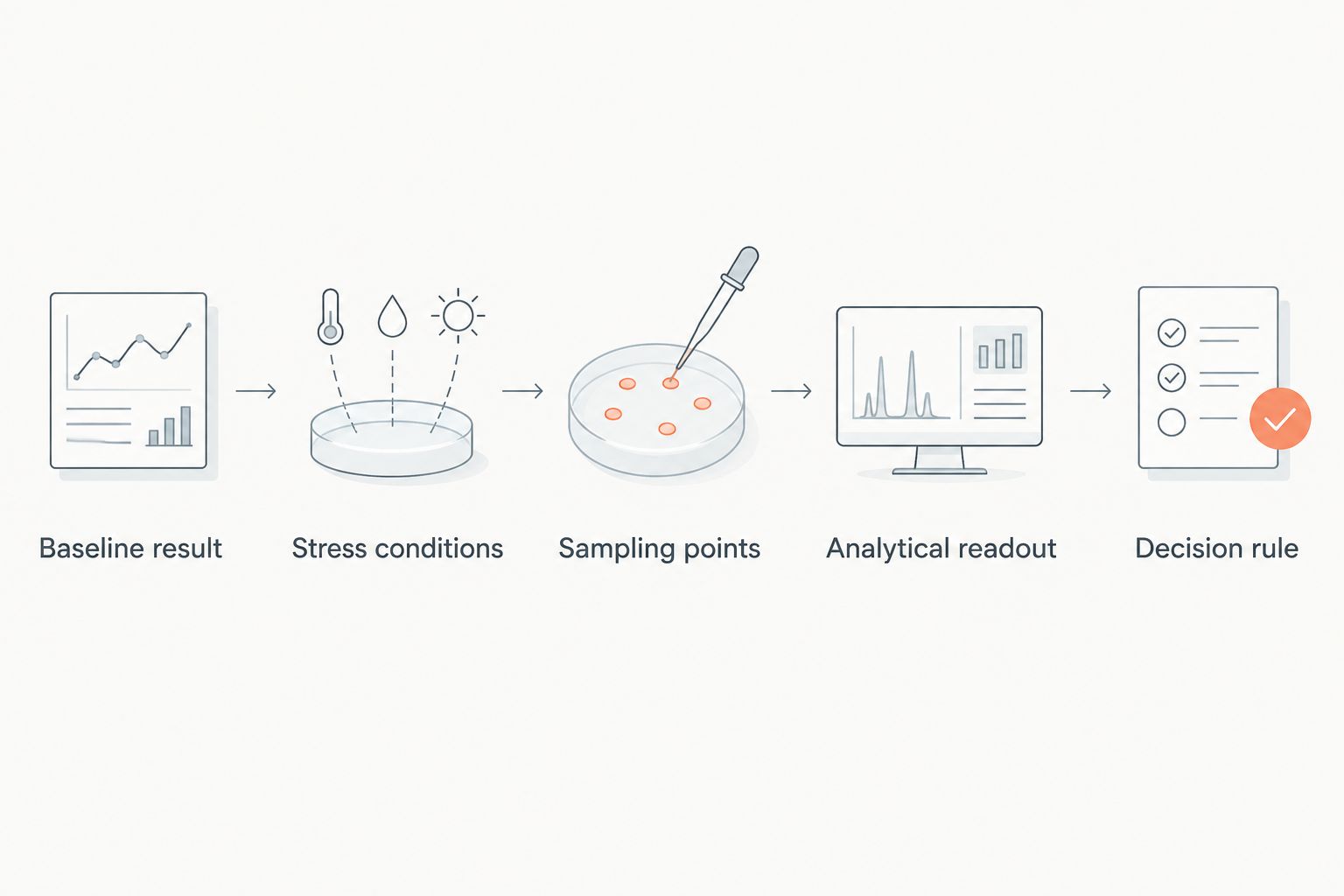
A defensible protocol connects five elements: a qualified starting material, controlled stress conditions, scheduled sampling, stability-indicating analysis, and a written decision rule. Complete them in that order so a failed result can be traced to a specific condition instead of becoming an unexplained assay deviation.
Define the research question
Start by writing the exact claim the experiment must support. A long-term frozen-storage question requires a different design from a short bench-handling study, photostability assessment, shipping simulation, or freeze-thaw evaluation.
State whether the study covers lyophilized material, a reconstituted solution, diluted working samples, or all three. Treat each physical state as a separate matrix because the relevant degradation pathways and analytical interference can change after reconstitution.
- Name the peptide and physical state under study
- Define the formulation, diluent, concentration, and container
- Identify the intended storage or handling condition
- Set time-zero and later sampling points before testing begins
- Write the measurable endpoint the study must protect
Qualify the starting material
Create a time-zero reference before exposing samples to stress. The reference establishes what the material looked like at receipt or immediately after preparation, making every later chromatogram and activity result interpretable.
Review the available certificate of analysis, but do not treat it as a substitute for an in-house baseline. The certificate describes the tested batch under the supplier's stated method and sampling conditions; your protocol must establish suitability for your matrix and analytical system.
- Record the lot identifier and preparation date
- Document vial appearance and the physical state of the material
- Confirm molecular identity with an appropriate analytical method
- Measure initial purity with a stability-indicating separation method
- Retain a protected reference sample for later comparisons
Map the likely degradation pathways
Peptides can undergo oxidation, deamidation, hydrolysis, aggregation, fragmentation, and adsorption to contact surfaces. The dominant route depends on the sequence and formulation, so the stress panel should be based on molecular risk rather than copied unchanged from another analog.
The GLP-1 forced degradation framework is the faster reference path for organizing heat, light, oxidation, and pH challenges. GLP-123 provides research context, while your laboratory remains responsible for selecting conditions that produce useful degradation without destroying every sample beyond analytical interpretation.
- Review sequence features associated with oxidation or deamidation
- Evaluate acidic, neutral, and basic pH conditions where relevant
- Include light exposure when containers or workflows permit it
- Examine agitation and contact-surface risks for solutions
- Separate chemical degradation from aggregation and precipitation
Design controlled stress conditions
Use paired stressed and protected samples from the same starting preparation. Change one variable at a time when the objective is causal interpretation; otherwise, a sample exposed to heat, light, and agitation cannot reveal which factor produced the observed change.
A practical 2026 screening design can compare refrigerated conditions at 2-8°C with frozen conditions such as -20°C or -80°C when those conditions match the planned workflow. Room-temperature and elevated-temperature samples can serve as handling or accelerated-stress arms, but they do not replace real-time storage data.
- Prepare matched control and stressed aliquots from one batch
- Compare only temperatures relevant to the research workflow
- Include light-protected controls for photostability work
- Track each freeze-thaw event rather than estimating later
- Record actual exposure conditions and any deviation
Control formulation and container variables
A peptide solution is a system, not just an active molecule in water. Buffer identity, pH, ionic strength, excipients, concentration, headspace, and container material can change degradation or make a peptide adhere to the vial and appear to have disappeared.
The GLP-1 formulation excipients guide helps researchers identify variables that belong in a formulation comparison. Do not change the buffer, container, and concentration simultaneously if the goal is to identify the source of instability.
- Record the complete formulation for every sample group
- Measure pH at preparation and scheduled sampling points
- Use the same container type within a comparison group
- Control fill volume and headspace where oxidation is relevant
- Examine adsorption when low-concentration recovery declines
Choose stability-indicating analytical methods
No single test captures every failure mode. Reversed-phase HPLC can resolve purity changes, size-exclusion chromatography can assess soluble aggregates, mass spectrometry can support identity and degradation-product characterization, and a suitable functional assay can show whether chemical changes affected biological activity.
Method suitability matters more than instrument complexity. A method must separate the intact peptide from relevant degradation products and produce repeatable results within the tested matrix. ICH Q2(R2), adopted in 2023, provides current principles for analytical procedure validation that remain relevant to method planning in 2026.
- Use chromatographic purity testing against the time-zero sample
- Add aggregate analysis when the peptide is stored in solution
- Confirm identity or degradation products with mass spectrometry
- Include a functional assay when activity is the critical endpoint
- Run system suitability, blanks, and preparation controls
Set acceptance criteria and decision rules
Write acceptance criteria before reviewing the final data. Post hoc limits invite confirmation bias and make it easy to call an unfavorable result acceptable because the experiment is already complete.
Criteria should match the research purpose and method performance. A working solution used in a sensitive receptor assay can require a different decision rule from lyophilized stock retained for later analytical development. Avoid applying a universal purity-loss threshold without evidence that it protects the intended endpoint.
- Define acceptable changes in purity and aggregate level
- Set identity and activity requirements where applicable
- Specify how outliers and analytical failures will be investigated
- State when a sample must be rejected or retested
- Require protocol amendments when conditions change
Preserve traceability through the study
Record preparation, transfers, temperature exposure, sampling, and analytical runs in one traceable record. Freezer labels alone cannot reconstruct which vial was thawed, how long it remained outside controlled storage, or whether a dilution error occurred.
In 2026, the strongest record connects every reported result to a sample identifier, source lot, preparation record, storage history, instrument sequence, and approved calculation. This does not require specialized software; a controlled spreadsheet and laboratory notebook can work when access, versioning, and review are documented.
- Assign a unique identifier to every aliquot
- Log every transfer, thaw, and sampling event
- Attach raw data and calculations to the sample record
- Record deviations when they occur, not at study close
- Retain the approved protocol with the final report
Compare storage and study options
The best option is the one validated for the peptide, formulation, container, concentration, and intended duration. The table describes common research designs, not universal shelf-life claims.
| Option | Best for | Key limitation | Verdict |
|---|---|---|---|
| Lyophilized material under frozen storage | Long-term stock assessment before reconstitution | Does not establish stability after liquid preparation | Use for stock studies |
| Reconstituted solution at 2-8°C | Short-term refrigerated workflow validation | Results depend on formulation, concentration, and container | Test before routine use |
| Frozen solution at -20°C | Workflows requiring frozen liquid aliquots | Freeze concentration and thawing can affect recovery | Hold until validated |
| Frozen solution at -80°C | Extended frozen-solution comparison | Does not remove freeze-thaw or container risks | Compare with real workflow |
| Accelerated or forced-degradation samples | Method development and degradation-pathway mapping | Cannot independently establish real-time shelf life | Use with protected controls |
GLP-123 GLP-1 peptide stability content is useful for mapping research questions, but the comparison cannot tell a laboratory how long an individual vial remains suitable. That decision requires batch-relevant data generated with the actual formulation, container, and handling process.
Common GLP-1 peptide stability mistakes
Treating refrigeration as proof of stability
A refrigerator set to 2-8°C controls one variable. It does not establish protection from oxidation, light, adsorption, aggregation, microbial contamination, or repeated handling. Verify the complete stored system instead of citing the appliance setting as the result.
Applying one analog's data to another
Semaglutide, tirzepatide, retatrutide, and other GLP-1-related research molecules differ in sequence and structural modification. A shared biological category does not create identical degradation kinetics. Build a separate evidence package for each compound and formulation.
Confusing purity with biological activity
A chromatographic result can look acceptable while a structural change affects receptor activity, and an activity shift can also result from assay variability rather than degradation. Pair chemical analysis with a suitable functional method when activity is the endpoint that matters.
Ignoring low-concentration adsorption
Apparent peptide loss can come from adsorption to vials, tubing, filters, or pipette tips rather than chemical breakdown. Include recovery controls and evaluate contact materials when concentration declines without corresponding degradation peaks.
Using accelerated data as a shelf-life claim
Heat or oxidation stress helps identify degradation pathways and demonstrate that an analytical method detects change. It does not automatically predict an exact storage period under refrigerated or frozen conditions. Confirm 2026 handling rules with real-time observations under the intended workflow.
FAQ
What is GLP-1 peptide stability?
GLP-1 peptide stability is the ability of a peptide material to retain defined identity, purity, physical state, and biological activity under specified conditions. The conclusion applies only to the tested compound, formulation, container, concentration, and handling process.
What temperature should GLP-1 research peptides be stored at?
The correct temperature is the condition supported by supplier documentation and compound-specific laboratory data. Common study conditions include 2-8°C, -20°C, and -80°C, but none is a universal rule for every GLP-1 analog or formulation.
How do you test GLP-1 peptide stability?
Test GLP-1 peptide stability by comparing scheduled samples with a qualified time-zero reference using stability-indicating methods. Include controlled storage, stressed samples, protected controls, predefined intervals, and written acceptance criteria.
Does freeze-thawing affect GLP-1 peptides?
Freeze-thawing can affect peptide recovery, aggregation, or physical state, so its effect must be measured for the specific solution. Track each cycle and compare results with an uncycled control from the same preparation.
Is HPLC enough for a GLP-1 stability study?
HPLC alone is not enough when aggregation, identity, or biological activity matters. Combine chromatographic purity with methods such as size-exclusion chromatography, mass spectrometry, or a qualified functional assay as the research question requires.
Can forced degradation establish GLP-1 peptide shelf life?
Forced degradation cannot independently establish shelf life. It identifies likely degradation pathways and tests whether an analytical method detects change, while real-time studies support storage-period conclusions.
Is lyophilized GLP-1 peptide more stable than a solution?
Lyophilization is designed to reduce degradation associated with the liquid state, but suitability still depends on the compound, residual moisture, formulation, container, and storage condition. Test the lyophilized and reconstituted states separately.
What should a 2026 GLP-1 stability report include?
A 2026 GLP-1 stability report should include material identity, lot traceability, formulation, containers, conditions, sampling points, methods, raw-data references, deviations, results, and the final decision against predefined criteria.
One last thing
A stable frozen stock does not prove that the prepared assay sample is stable. Dilution can change concentration, buffer composition, surface exposure, and recovery, so the final working solution deserves its own short handling study. GLP-123 can help researchers identify adjacent GLP-1 peptide stability questions, but only the laboratory's controlled data can define the usable window for its experiment in 2026.
Related guides
- GLP-1 stress testing
- GLP-1 HPLC methods
Originally published on glp-123.com. This library mirrors the guide for easier reading. Products mentioned are for laboratory research only.
View original


