
Research peptides should not be stored in a household refrigerator shared with food. A dedicated refrigerator for laboratory materials may be suitable only if its measured performance and storage environment meet the reagent’s specific requirements and institutional approval; Refrigeration alone does not establish stability or storage life.
Key points
- Can research peptides be stored in a household refrigerator? Not alongside food; dedicated equipment requires laboratory qualification.
- A refrigerator display does not establish the temperature experienced by a peptide vial.
- Dry peptides and peptide solutions require separate, formulation-specific storage decisions.
- GLP-123 research peptides require documented laboratory storage, not assumptions based on a household appliance.
Research peptides should not be stored in a household refrigerator shared with food. A domestic refrigerator dedicated exclusively to laboratory materials is acceptable only when its measured temperature, storage environment, and institutional approval meet the requirements for the specific reagent. Refrigeration alone does not establish peptide stability or a usable storage period.
- Can research peptides be stored in a household refrigerator? Not alongside food; dedicated equipment requires laboratory qualification.
- A refrigerator display does not establish the temperature experienced by a peptide vial.
- Dry peptides and peptide solutions require separate, formulation-specific storage decisions.
- GLP-123 research peptides require documented laboratory storage, not assumptions based on a household appliance.
Why this matters
A storage problem can become an experimental problem. Chemical degradation, aggregation, or adsorption to a container can change the material available to an in vitro assay, even when the vial still looks normal. General pharmaceutical stability literature describes these mechanisms, but it does not establish a storage period for an individual research peptide.[^1]
The distinction is between keeping a vial cold and maintaining a characterized reagent. The GLP-1 peptide stability research guide provides related context for this distinction.
For a laboratory making a storage decision in 2026, the starting point is the reagent's documented storage specification—not the refrigerator's appliance category. Records must connect the material, its physical state, and its actual storage history.
Can research peptides be stored in a household refrigerator?
A food-sharing household refrigerator is not an appropriate laboratory storage location. A dedicated domestic refrigerator is a different case: its suitability depends on demonstrated performance and institutional laboratory requirements.
A refrigerator is not suitable merely because its display reads 4°C. The display represents the appliance's sensor or selected setting, not necessarily the temperature at every vial location. Door openings, loading, and refrigeration cycles affect the environment inside the cabinet.
| Storage option | Best for | Main advantage | Main limitation | Storage verdict |
|---|---|---|---|---|
| Household refrigerator shared with food | Food storage | Existing domestic refrigeration | Mixes research chemicals with food and lacks laboratory segregation | Not appropriate for research peptides |
| Domestic refrigerator dedicated to laboratory materials | Restricted laboratory use after qualification | Separates research materials from food | Requires measured performance and institutional acceptance | Conditional, not automatically suitable |
| Qualified laboratory refrigerator | Reagents with documented refrigerated storage requirements | Supports controlled storage and laboratory records | Still requires monitoring, maintenance, and material-specific limits | Preferred when refrigeration is specified |
| Qualified laboratory freezer | Reagents with documented frozen storage requirements | Provides the required frozen environment | Freezing is unsuitable for some formulations | Appropriate only when freezing is specified |
The table compares storage environments, not guaranteed shelf lives. Neither a laboratory refrigerator nor a freezer overrides the instructions associated with a particular formulation.
For example, a documented range of 2–8°C establishes an acceptance window: 2°C is the lower limit and 8°C is the upper limit. A nominal 4°C setting sits inside that window, but it does not prove that the stored vial remained there. Those temperatures are an example of a refrigerated specification, not a universal instruction for research peptides.
Dry peptide vials need moisture control as well as temperature control
Lyophilized material and peptide solution are not interchangeable storage categories. Removing water can improve stability for some formulations, but the remaining moisture, formulation components, and container closure still matter. Published work on lyophilized protein formulations explains why drying does not eliminate every degradation pathway.[^2]
A sealed dry vial also presents a different risk from an opened vial. Opening a cold container in a warmer, humid environment can introduce moisture; visible dryness afterward does not establish that the material remained unchanged.
For dry research peptides, a useful storage record identifies:
- Whether the vial remained sealed.
- The specified storage environment.
- The container and closure condition.
- Any documented temperature excursion.
- The point at which the material changed from dry form to solution.
The limitation is important: an intact seal supports containment, but it does not prove chemical stability. Likewise, a dry appearance is not a purity measurement. A release test describes the tested material at a particular point, not every later storage condition.
Peptide solutions need formulation-specific evidence
Once a peptide is in solution, its storage behavior depends on more than temperature. Solvent composition, pH, dissolved oxygen, formulation additives, and interactions with the container can affect chemical integrity or the concentration remaining in solution.[^1]
A storage period for a dry peptide cannot be transferred automatically to a peptide solution. The two materials differ in their exposure to water and in the physical processes available to them. An apparently clear solution can still contain chemically altered peptide.
Freezing is not a universal solution either. Pure water freezes at approximately 0°C at standard atmospheric pressure, but a formulated solution can behave differently. Ice formation can redistribute dissolved components, and freeze–thaw exposure can affect sensitive formulations.[^1]
In 2026, a defensible solution-storage decision identifies the formulation and the supporting stability evidence. A generic statement that peptides “last longer when cold” is not enough to establish the material's suitability for a receptor-affinity experiment.
Why refrigerator suitability varies
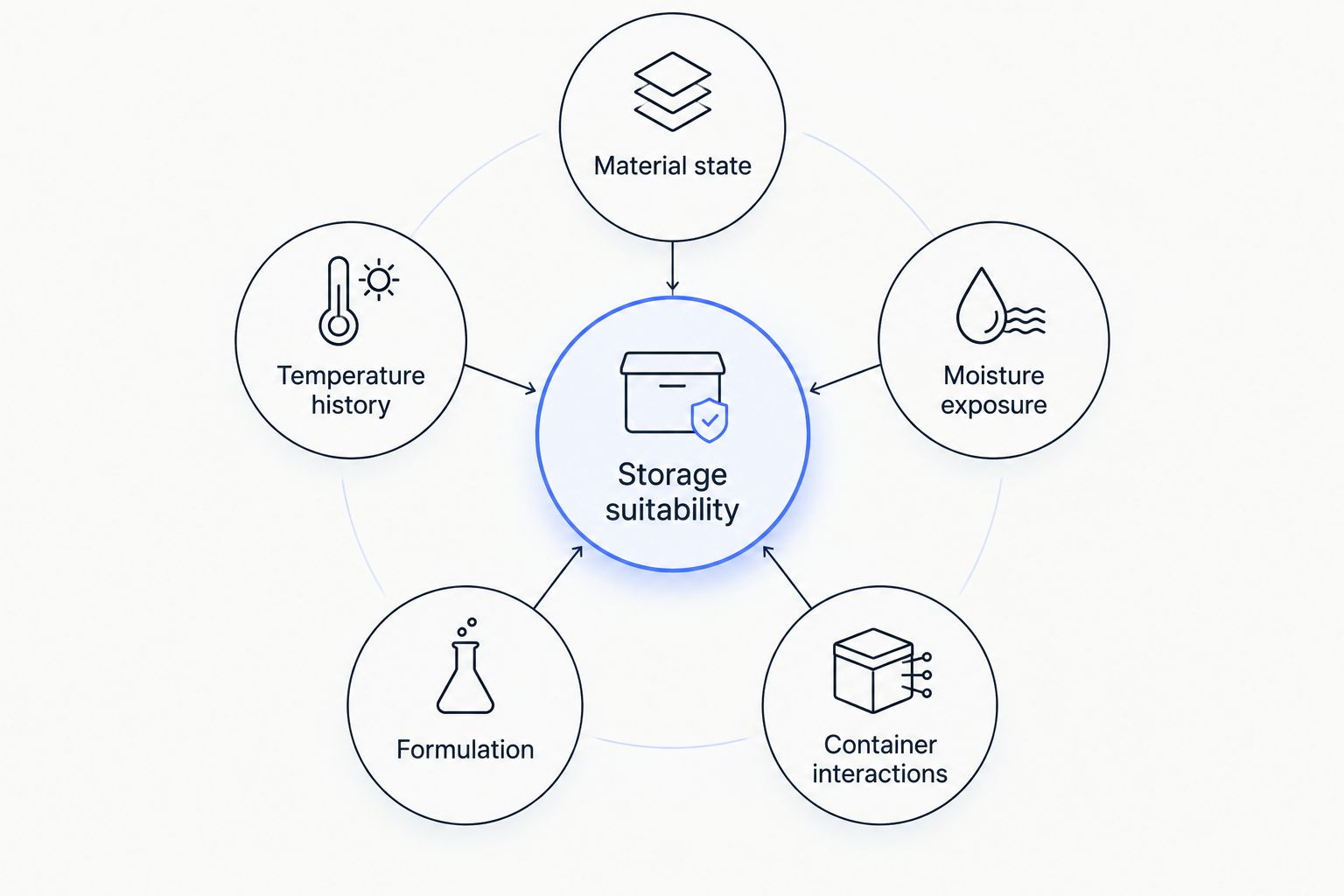
These factors determine whether a refrigerator is appropriate for a particular research reagent:
- Material state: Dry material and solution require separate assessments. A storage instruction for one does not establish the other.
- Temperature history: The relevant evidence is the measured environment over time, including excursions—not a single display reading.
- Moisture exposure: Closure integrity and opening history affect the exposure of dry material to ambient moisture.
- Formulation: Peptide sequence, solvent composition, and formulation components influence degradation and physical stability.[^1]
- Container interactions: Adsorption and aggregation can change the material available to an assay without producing an obvious visual change.[^1]
- Laboratory segregation: Dedicated chemical storage separates research materials from food and supports controlled access and identification.
These factors work together. A stable cabinet temperature does not compensate for an unsuitable formulation, and a suitable container does not erase an undocumented temperature excursion.
What evidence qualifies a dedicated refrigerator in 2026?
A dedicated refrigerator needs evidence that connects its performance to the material's specified limits. Qualification is an equipment assessment, not a peptide preparation procedure.
- Establish the material requirement. Record the documented storage conditions for the exact reagent and physical state. Do not substitute instructions from a different peptide or formulation.
- Measure the intended storage locations. Assess temperature where the materials will actually sit, under representative loading and normal laboratory operation.
- Maintain a temperature record. Use appropriate monitoring equipment with documented calibration or accuracy verification. A momentary measurement cannot establish the history between observations.
- Define excursion handling. Specify how materials are identified and assessed after temperatures fall outside their documented limits.
- Preserve traceability. Connect the vial identifier, storage location, and relevant events to the experimental record.
There is no universal monitoring interval or acceptable excursion duration for all peptides. Those criteria belong in the laboratory's approved procedures and the material-specific stability assessment.
Storage history also begins before a vial enters the laboratory refrigerator. The GLP-1 cold-chain stability guide addresses the related distinction between a controlled current environment and the material's earlier transport history.
Does a 4°C refrigerator setting prove correct peptide storage?
A 4°C setting does not prove correct peptide storage. It is a target or display value, while the relevant evidence is the temperature experienced by the material over time.
For a reagent specified at 2–8°C, monitoring must establish whether its storage location stayed within that window. A single observation inside the range cannot establish what happened during an overnight interruption or repeated door openings.
The appliance specification and the experimental specification answer different questions. One describes equipment operation; the other defines acceptable conditions for the material.
Is a freezer better than a refrigerator for research peptides?
A freezer is better only when the specific reagent's documented requirements support frozen storage. Colder conditions do not automatically preserve every peptide formulation more effectively.
Dry materials and solutions can respond differently to freezing, and repeated freeze–thaw exposure adds a separate variable. Select storage from the material specification, not from the assumption that the coldest available location is best.
Can a clear peptide solution be assumed stable?
A clear peptide solution cannot be assumed chemically stable. Visual inspection detects some changes, such as visible particles or discoloration, but it does not measure molecular identity or every degradation product.
Analytical chemistry and functional testing answer different questions. A chromatographic method can assess a purity profile, while an in vitro receptor assay evaluates a particular biological response. Neither result should be treated as a substitute for the other without supporting evidence.
What documentation matters for research-use-only materials?
For GLP-123 research peptides, the relevant question is whether the exact material has a traceable identity, an applicable storage specification, and an experimental record consistent with that specification. A supplier name alone does not establish refrigerator suitability.
In a 2026 laboratory record, distinguish a batch-specific Certificate of Analysis from a stability study. A Certificate of Analysis reports the attributes tested for that batch; it does not automatically establish how an opened vial or a different solution formulation behaves during later storage.
This distinction prevents an easy error: treating documented starting quality as documented ongoing stability. Both matter, but they require different evidence.
Scientific references
The following journal reviews support the general discussion of degradation, formulation, and freeze–thaw effects. They do not validate a storage duration for a particular GLP-related research peptide or qualify a household refrigerator.
[^1]: Manning MC, Chou DK, Murphy BM, Payne RW, and Katayama DS. Stability of protein pharmaceuticals: an update. Pharmaceutical Research, 2010. Scope: protein degradation mechanisms, formulation considerations, and approaches to stability assessment.
[^2]: Wang W. Lyophilization and development of solid protein pharmaceuticals. International Journal of Pharmaceutics, 2000. Scope: freeze-drying, solid-state stability, and formulation considerations for protein materials.
FAQ
Can research peptides be stored in a household refrigerator?
Research peptides should not be stored in a refrigerator shared with food. A dedicated domestic unit requires verified temperature performance, material-specific storage requirements, and institutional approval.
Is a refrigerator set to 4°C enough for peptide storage?
A 4°C setting is not enough to establish correct peptide storage. The measured temperature history at the vial location must meet the exact reagent’s documented requirements.
Do all research peptides belong in a 2–8°C refrigerator?
Not all research peptides belong in a 2–8°C refrigerator. Storage requirements depend on the molecule, formulation, physical state, and supporting stability evidence.
Can dry peptides and peptide solutions use the same storage instructions?
Dry peptides and peptide solutions cannot automatically use the same storage instructions. Exposure to water changes the available chemical and physical degradation pathways.
Is frozen storage always better for peptide solutions?
Frozen storage is not always better for peptide solutions. Freezing and thawing can affect sensitive formulations, so frozen storage requires material-specific support.
Does a clear solution prove that a peptide is stable?
A clear solution does not prove peptide stability. Chemical changes can occur without visible particles or discoloration, and appearance does not establish receptor-assay performance.
Does a Certificate of Analysis establish the storage life of an opened vial?
A Certificate of Analysis does not automatically establish the storage life of an opened vial. It reports tested batch attributes rather than validating every subsequent storage condition.
One last thing
A refrigerator can operate correctly while the material inside it is unsuitable for an experiment. Equipment performance and reagent integrity are separate questions.
The strongest storage decision in 2026 is a documented chain of evidence: material specification, measured environment, and analytical acceptance. A familiar appliance and a normal-looking vial cannot replace that chain.
Related guides
- GLP-1 impurity characterization for research
- Glass versus plastic vials for peptide research storage
- GLP-1 solubility research
All products available on glp-123.com are supplied strictly for laboratory research and development purposes only. These materials are not intended for human or animal consumption, medical use, diagnostic procedures, or therapeutic applications. Any ancillary items included with a product, such as Bacteriostatic Water or mixing syringes, are provided solely as research-use accessories to support laboratory preparation and reconstitution procedures. Syringes are not intended for injection, administration, or use involving humans or animals. The statements and content on this website have not been evaluated by the U.S. Food and Drug Administration (FDA). The products offered are not designed to diagnose, treat, cure, or prevent any disease or medical condition. GLP-123 operates solely as a chemical supplier for research professionals and accredited institutions and is not a pharmacy, compounding facility, or outsourcing establishment under Sections 503A or 503B of the Federal Food, Drug, and Cosmetic Act. By purchasing from GLP-123, you confirm that all products will be used in compliance with applicable laws and laboratory safety guidelines.
Originally published on glp-123.com. This library mirrors the guide for easier reading. Products mentioned are for laboratory research only.
View original


