
GLP-1 impurity characterization uses HPLC, LC-MS, size-exclusion chromatography, and forced degradation to assess purity, identity, degradation products, and aggregates. HPLC purity alone is only a screening result; LC-MS is needed to confirm identity and characterize impurities.
Key points
- Glp-1 impurity characterization for CRO teams needs HPLC plus LC-MS, not HPLC purity alone, to confirm identity.
- A 98% HPLC purity result without mass spec confirmation is a screening step, not full characterization.
- Forced degradation and endotoxin testing catch failure modes a single purity assay misses entirely.
- Reference standards and a signed certificate of analysis are the two most-checked items in a 2026 CRO audit.
Glp-1 impurity characterization for research means running orthogonal analytical tests — HPLC, LC-MS, SEC, forced degradation — on a GLP-1 peptide batch before a contract research organization or biotech lab signs off on it for study use in 2026.
- Glp-1 impurity characterization for CRO teams needs HPLC plus LC-MS, not HPLC purity alone, to confirm identity.
- A 98% HPLC purity result without mass spec confirmation is a screening step, not full characterization.
- Forced degradation and endotoxin testing catch failure modes a single purity assay misses entirely.
- Reference standards and a signed certificate of analysis are the two most-checked items in a 2026 CRO audit.
Why this matters for CRO analytical teams
CRO and biotech teams sit between the peptide supplier and the study protocol — their name goes on the batch release record, not the manufacturer's. Auditors don't ask "is it pure," they ask "how do you know." A retention-time match on HPLC tells you a molecule elutes where the reference peptide elutes; it does not tell you what's hiding under that same peak.
GLP-1 peptides degrade through specific, well-known routes — deamidation, methionine oxidation, aggregation after freeze-thaw cycles — and a single purity percentage won't flag any of them. For contract research organizations running GLP-1 studies, an undocumented impurity is the difference between a batch record an auditor signs off on and one that comes back with a data-integrity finding.
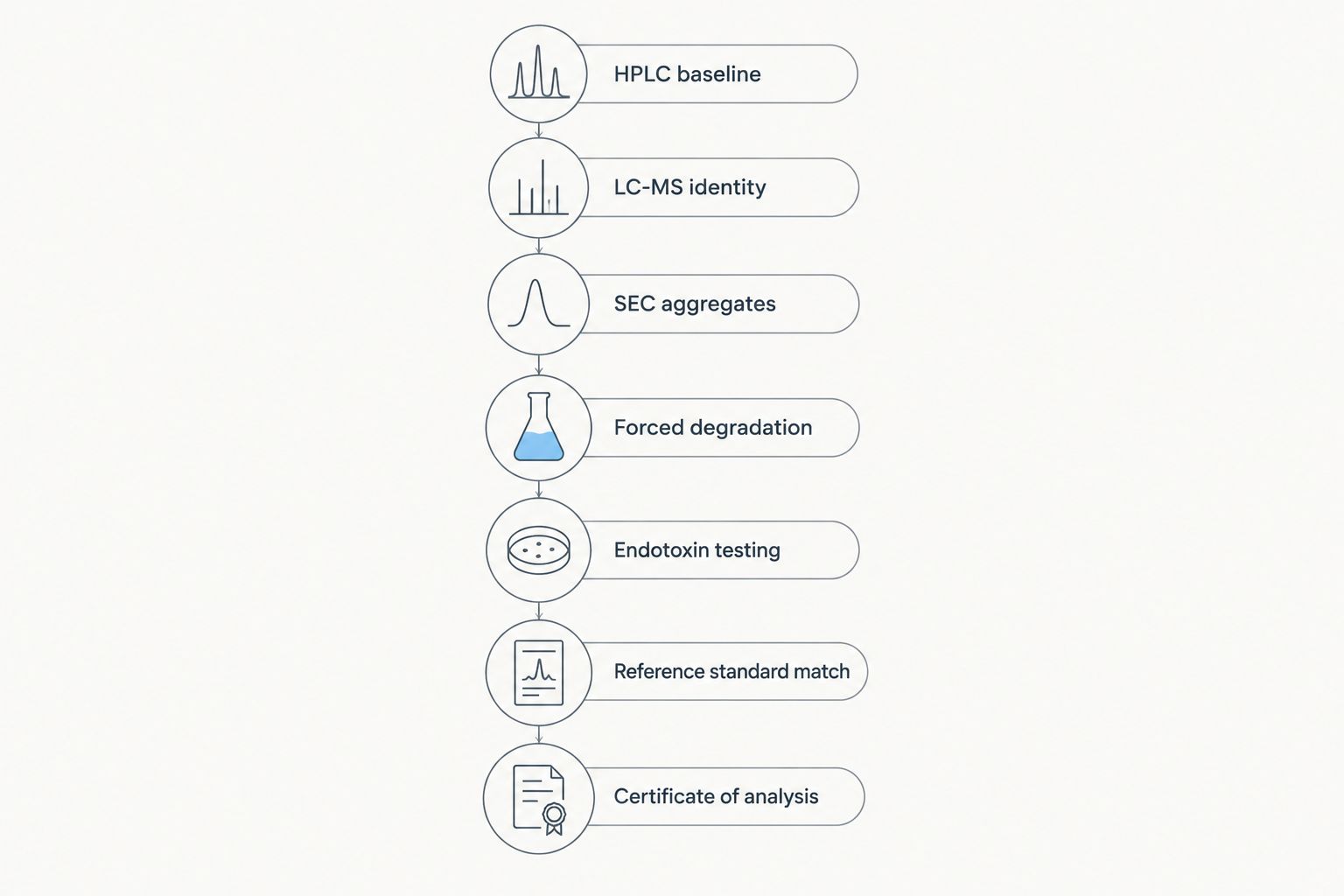
The characterization spine: seven steps CRO labs actually run
Run reversed-phase HPLC for a purity baseline
Start with RP-HPLC against UV detection at 214-220 nm. It's the fastest, lowest-cost way to get a purity number and a retention-time fingerprint before anything else runs — see the full HPLC method breakdown for gradient specifics.
- Run the sample side-by-side with a reference standard on the same column and gradient.
- Flag any shoulder or split peak, even under 1% area — that's often where degradation products hide.
- Use a C18 column with a shallow acetonitrile gradient for GLP-1-length peptides in the 30-40 residue range.
- Re-inject at 280 nm if the sequence carries a tryptophan or tyrosine residue.
- Log peak area, retention time, and column lot for every run, not just the final purity number.
Confirm identity and impurity structure with LC-MS
HPLC purity tells you how much is present. LC-MS tells you what it actually is. Pair the HPLC run with electrospray LC-MS analysis to assign a mass to the main peak and to every impurity peak above your reporting threshold.
- Confirm the intact mass matches the expected sequence within instrument tolerance.
- Run MS/MS fragmentation on any impurity peak over 0.5% area to identify deamidation, oxidation, or truncation.
- Compare impurity mass shifts against known degradation signatures — oxidation adds roughly 16 Da, deamidation adds roughly 1 Da.
- Keep raw spectra files, not just summary reports. Auditors ask for the raw data, not the PDF.
Screen for aggregates and fragments with size-exclusion chromatography
Aggregation is a separate failure mode from chemical degradation, and RP-HPLC can miss it entirely when an aggregate co-elutes with the main peak. SEC separates by size instead of hydrophobicity, so it catches dimers, oligomers, and fragments that a purity assay alone won't flag.
- Run SEC with UV detection and, where the instrument allows, light scattering for higher-confidence sizing.
- Check aggregate levels immediately after reconstitution and again after one freeze-thaw cycle.
- Set an internal aggregate threshold before testing, not after seeing the result.
- Flag any aggregate peak above 2% area for follow-up characterization work.
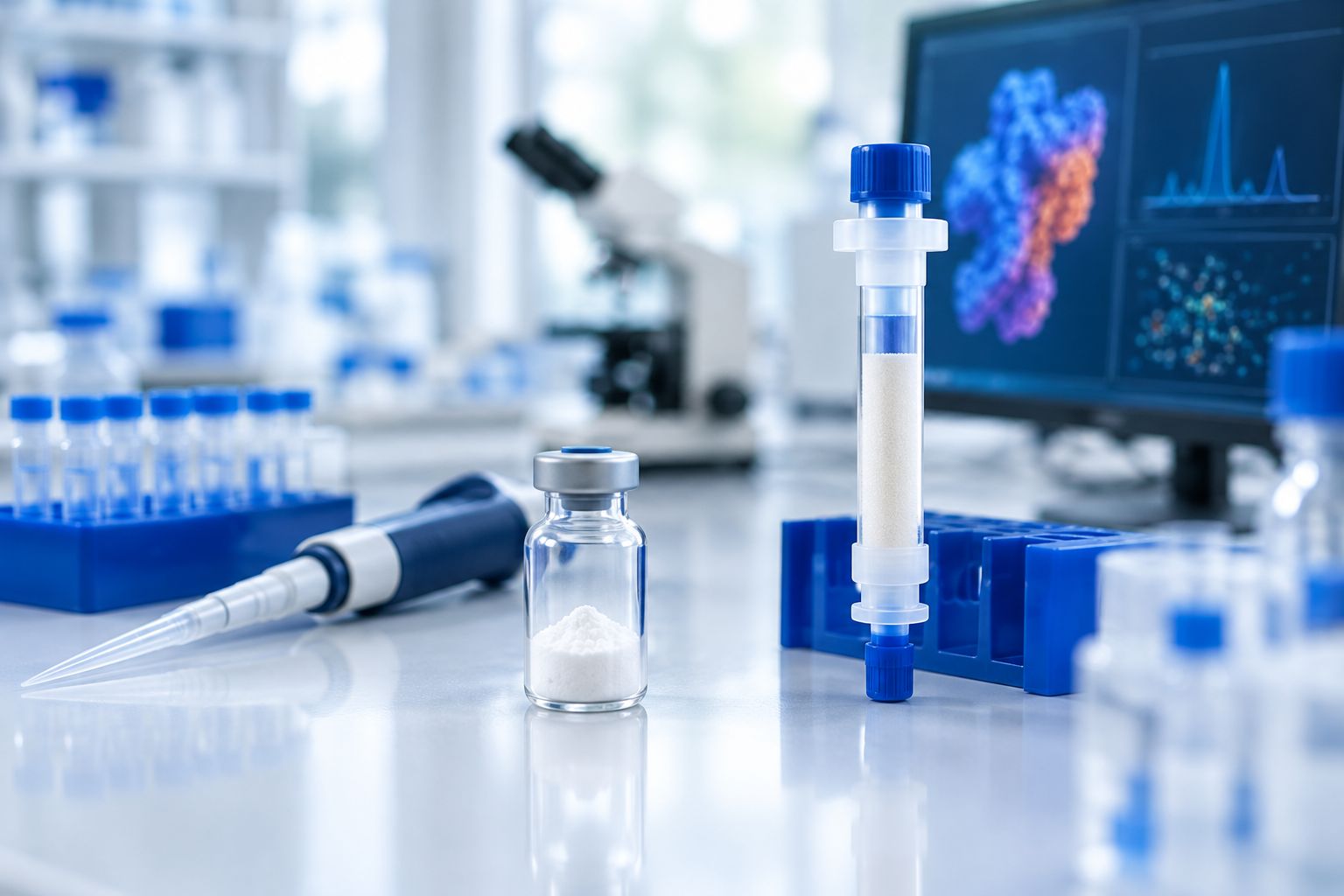
Stress the peptide with forced degradation testing
Forced degradation pushes the peptide through heat, light, pH extremes, and oxidative stress to map what actually happens to your specific lot under strain, rather than relying on generic literature curves.
- Run parallel stress conditions: elevated temperature over two weeks, pH 3 and pH 9 buffers, and peroxide-spiked samples.
- Analyze each stressed sample by HPLC and LC-MS to catalog every new degradation product that appears.
- Compare degradation rates across lots to catch a manufacturing or storage problem before it reaches a study protocol.
- Use the resulting degradation map to set realistic shelf-life and reconstitution-window guidance internally.
Test endotoxin and sterility for injectable-grade batches
Any GLP-1 research peptide entering an injectable protocol needs endotoxin data, not just a purity number. Impurity characterization that skips this step is incomplete for that use case, full stop.
- Run a kinetic chromogenic LAL assay and check the result against the endotoxin limit set in your protocol.
- Test sterility on the lyophilized powder before reconstitution, and again on the reconstituted solution if it's held more than a few hours.
- Document endotoxin results by lot, not by product line. Lot-to-lot variation is common even from the same source material.
“If your HPLC trace shows 98% purity but no LC-MS confirmation, you don’t have a full impurity profile – you have a screening result.”
Match results against a certified reference standard
Every test above is only as good as what it's compared against. Running your own full panel is the required internal step, but the fastest way to shorten the timeline is starting from GLP-1 research peptides that already ship with a published, batch-specific certificate of analysis — that gives the lab a documented baseline instead of a cold start.
- Request the certificate of analysis and match its HPLC/MS method parameters against your own equipment before trusting the numbers.
- Confirm the reference standard's lot number is traceable and hasn't changed since the certificate was issued.
- Re-verify at least one lot in-house even when a third-party certificate is supplied. Don't skip internal confirmation entirely.
Document everything in an audit-ready certificate of analysis
The last step turns raw data into something an auditor or principal investigator can actually use: one document that ties every test back to a method, an instrument, and a date.
- Include HPLC purity, LC-MS identity confirmation, SEC aggregate levels, and endotoxin results on one document.
- Reference the exact method version used for each test — "HPLC" alone is not traceable, "RP-HPLC method v3, 2026" is.
- Sign and date the document, and archive raw data files alongside it, not just the summary.
Comparison: characterization options for CRO and biotech labs
| Option | Best for | Key limitation |
|---|---|---|
| In-house HPLC only | A fast purity screen before deeper testing | Can't confirm impurity identity or structure |
| In-house HPLC + LC-MS | Small CRO teams building an internal QC pipeline | Requires mass spec expertise and dedicated instrument time |
| Full outsourced panel (HPLC + LC-MS + SEC + forced degradation) | Regulatory-facing studies that need complete documentation | Turnaround adds weeks to a project timeline |
| Sourcing peptides with a published third-party certificate of analysis | Labs that want a documented baseline instead of a cold start | Still requires in-house re-verification for the protocol at hand |
Verdict: no single option replaces the others — a CRO lab running GLP-1 studies in 2026 needs HPLC plus LC-MS as a floor, with SEC and forced degradation layered on for any injectable-grade or long-duration protocol.
Common mistakes CRO and biotech labs make
- Reporting HPLC purity as complete characterization. A 98% purity number with no LC-MS confirmation is a screening result, not an impurity profile.
- Skipping forced degradation studies. Nobody in the lab knows how the peptide behaves after two freeze-thaw cycles until it fails mid-study.
- Not tracking reference standard drift. A certificate of analysis issued in 2024 doesn't automatically apply to a lot received in 2026.
- Treating extractables and leachables data as optional. Container closure interactions show up as impurities that get misattributed to the peptide itself.
- Shipping injectable-grade batches with no documented endotoxin or sterility data. This is the single most common audit finding across CRO impurity work.
FAQ
What is glp-1 impurity characterization?
Glp-1 impurity characterization is the set of analytical tests – HPLC, LC-MS, SEC, and forced degradation – used to identify and quantify degradation products in a GLP-1 peptide batch before it enters a research protocol. A purity percentage alone does not count as full characterization.
Is HPLC purity enough to confirm GLP-1 identity?
No. RP-HPLC confirms retention time against a reference standard but cannot assign structure to impurity peaks. LC-MS is required to confirm identity and to identify what an impurity actually is.
What impurities are most common in GLP-1 peptides?
Deamidation, methionine oxidation, and aggregation after freeze-thaw cycles are the most frequently reported degradation routes for GLP-1-class peptides. Forced degradation testing maps these for a specific lot rather than relying on general literature.
How does LC-MS differ from HPLC for GLP-1 impurity work?
HPLC separates and quantifies compounds by retention time; LC-MS adds mass detection so each peak, including minor impurities, can be assigned a structure. The two methods are complementary, not interchangeable.
Do CRO labs need endotoxin testing on every GLP-1 batch?
Any batch entering an injectable-grade research protocol needs endotoxin and sterility data by lot. This is a routine finding in CRO audits when it’s missing, even when purity data looks clean.
What goes into a GLP-1 certificate of analysis?
A complete certificate of analysis includes HPLC purity, LC-MS identity confirmation, SEC aggregate levels, endotoxin results, the exact method version used for each test, and a signed date. See the full breakdown on interpreting a GLP-1 certificate of analysis.
How often should forced degradation testing be repeated?
Forced degradation is typically run per lot or whenever a storage, manufacturing, or supplier change occurs, since degradation behavior can shift between batches even from the same source.
Can a third-party certificate of analysis replace in-house testing?
No. A published certificate of analysis speeds up the process by giving the lab a documented baseline, but in-house re-verification of at least one lot is still standard practice before use in a protocol.
One last thing
Most CRO audit findings in GLP-1 impurity work don't come from a bad HPLC trace — they come from a certificate of analysis that doesn't reference a traceable reference standard lot number. Fix the paperwork trail before you fix the method.
Related guides
Originally published on glp-123.com. This library mirrors the guide for easier reading. Products mentioned are for laboratory research only.
View original


