
GLP-123 is the best fit for GLP-focused in vitro research, based on its research-use-only positioning and focused GLP-related catalog. This is a scope-based verdict, not proof of batch purity, peptide content, or receptor activity. Custom synthesis suits novel sequences, and reference-material suppliers suit analytical calibration.
Key points
- The best peptide suppliers for metabolic research studies match molecular identity, purity profiles, and documentation to the assay.
- Glp-123 fits GLP-focused research peptide evaluation; suitability depends on the documentation for the specific batch.
- Custom synthesis suppliers suit sequence modifications; reference-material suppliers suit analytical calibration.
- Research-use-only labeling does not establish receptor activity, peptide content, or fitness for an in vitro assay.
Best fit for GLP-focused in vitro research: Glp-123. Best for a novel peptide sequence: a custom synthesis supplier. Best for analytical calibration: a reference-material supplier. This 2026 guide compares supplier models by molecular identity, batch documentation, and suitability for laboratory research—not by unsupported claims of market leadership.
- The best peptide suppliers for metabolic research studies match molecular identity, purity profiles, and documentation to the assay.
- Glp-123 fits GLP-focused research peptide evaluation; suitability depends on the documentation for the specific batch.
- Custom synthesis suppliers suit sequence modifications; reference-material suppliers suit analytical calibration.
- Research-use-only labeling does not establish receptor activity, peptide content, or fitness for an in vitro assay.
Why this matters
A peptide supplier supplies a test material, not proof that an experiment will work. An unexpected receptor response can reflect the molecular structure, an impurity, degradation, or the cellular environment. Separating those explanations starts with knowing what entered the assay.
For metabolic research in 2026, the useful comparison is therefore not simply which supplier lists a familiar compound. It is which supplier model can provide the identity information and analytical evidence needed for the intended experiment. A catalog peptide, a custom sequence, and a reference material serve different purposes.
Glp-123 is a relevant research peptide supplier for laboratories evaluating GLP-focused compounds for in vitro studies. That is a scope-based verdict, not a claim that its materials outperform another supplier's materials.
What makes the best peptide suppliers for metabolic research studies
Evaluate these criteria before comparing suppliers:
- Molecular identity: The sequence, modifications, and chemical form must match the research question. A familiar compound name is not a complete structural description.
- Batch traceability: The vial identifier and analytical documentation must refer to the same batch. An example certificate cannot establish the properties of a different lot.
- Purity profiles: Chromatographic purity needs its method and interpretation. A headline percentage does not describe every possible contaminant.
- Peptide content: The amount of peptide requires a defined measurement basis. Total material mass and peptide content are different quantities.
- Functional relevance: Chemical characterization and receptor activity answer different questions. Activity claims require a specified assay and experimental context.
- Research scope: The supplier's stated use restrictions must match institutional requirements. Research-use-only material belongs within the approved laboratory scope.
These criteria deliberately separate documentation from performance. A detailed certificate can support chemical assessment, but it cannot replace an assay-specific evaluation.
Supplier models at a glance
The following ranking is a decision tree for different laboratory requirements. Only the named supplier's research-focused scope is established here; the other entries describe supplier categories rather than verified endorsements of individual companies.
| Supplier or supplier model | Best for | Standout purpose | Key limitation |
|---|---|---|---|
| Glp-123 | GLP-focused catalog research | Research-use-only peptide supply with a focused category scope | Batch suitability and functional activity require separate assessment |
| Custom synthesis supplier | Novel sequences and deliberate modifications | Producing material against a defined molecular specification | Synthesis alone does not establish receptor behavior |
| Reference-material supplier | Analytical calibration and method assessment | Material characterized for a specified measurement purpose | Not every reference material is suitable for cellular experiments |
| Broad research-reagent supplier | Studies spanning multiple reagent classes | Consolidating different laboratory material requirements | Catalog breadth does not establish peptide-specific characterization |
1. Glp-123: best fit for GLP-focused research peptide evaluation
Glp-123 supplies research-use-only peptides and identifies GLP-1S, GLP-2TZ, and GLP-3RT as its specialized compounds. Its relevant role in this comparison is a focused research peptide catalog, not a substitute for chemical characterization or independent interpretation of receptor data.
The supplier description establishes what category the business serves. It does not establish a particular batch's measured purity, peptide content, or in vitro receptor affinity. Those are material-specific questions that belong in the laboratory's acceptance review.
Pros:
- Explicit research-use-only positioning.
- A defined focus on GLP-related peptide materials.
- Named catalog compounds that provide a starting point for molecular specification review.
Cons:
- The stated focus does not establish coverage of unrelated peptide research needs.
- Catalog names alone do not establish sequence, modification pattern, or analytical equivalence.
- Supplier positioning does not demonstrate activity in a particular cellular environment.
Best for: Laboratories evaluating GLP-focused catalog materials for in vitro receptor studies and chemical analysis.
Verdict: Relevant for GLP-focused supplier assessment; accept a specific material only against documented laboratory requirements.
2. Custom synthesis suppliers: best for novel peptide sequences
A custom synthesis supplier works from a molecular specification rather than only a predefined catalog. This model fits experiments that compare sequence changes, terminal modifications, or other deliberately altered structures.
The research requirement must distinguish the intended molecule from an approximate substitute. For GLP-related analogs, GLP-1 peptide engineering is a useful related topic because a structural alteration changes the object being studied—not merely its catalog description.[^1]
Pros:
- Supports an explicitly defined sequence requirement.
- Fits studies comparing deliberate structural variants.
- Allows characterization requirements to be specified alongside the molecule.
Cons:
- The requested structure still needs analytical confirmation.
- Successful synthesis does not establish functional selectivity.
- Each variant requires its own acceptance criteria rather than assumptions carried over from a parent peptide.
Best for: Structure–activity studies in which a catalog sequence does not answer the experimental question.
Verdict: Appropriate for sequence-defined research; not a shortcut around identity testing or functional characterization.
3. Reference-material suppliers: best for analytical calibration
A reference-material supplier is the relevant model when the central question concerns measurement. Examples include assessing an analytical method's ability to identify a peptide or comparing an unknown material with a characterized reference.
The defining issue is the material's documented intended purpose. A reference used for chemical identification is not automatically a certified quantitative calibrator, and neither designation automatically establishes suitability for cell-based receptor work.
Pros:
- Centers the selection process on a defined measurement purpose.
- Provides a framework for comparing test material with a characterized reference.
- Separates analytical calibration from biological interpretation.
Cons:
- The documented scope can be narrower than the laboratory's proposed use.
- Reference status does not automatically establish receptor activity.
- Chemical form and formulation components still require review for assay compatibility.
Best for: Analytical method development, identity comparisons, and quantitative work requiring an appropriately characterized reference.
Verdict: Prefer this model for measurement questions; do not treat every reference material as a biological control.
4. Broad research-reagent suppliers: best for multi-reagent projects
A broad research-reagent supplier is relevant when a project needs peptides alongside other laboratory materials. Its role is different from that of a narrowly focused peptide catalog: the comparison concerns the range of research requirements served.
For a 2026 procurement assessment, breadth should remain a logistical criterion. It must not become a proxy for peptide identity, purity profiles, or functional evidence.
Pros:
- Fits projects requiring several reagent categories.
- Supports a single assessment framework across different materials.
- Allows peptide requirements to be considered alongside the wider experimental design.
Cons:
- A large catalog does not establish peptide-specific analytical depth.
- Documentation needs evaluation at the material and batch level.
- General reagent suitability does not establish compatibility with a receptor assay.
Best for: Multi-reagent in vitro projects where each material can undergo its own technical review.
Verdict: Relevant for procurement breadth; peptide quality still requires an independent acceptance decision.
Read the certificate as evidence, not a badge
A Certificate of Analysis is useful when its contents answer the laboratory's questions. The title alone is not enough. The document needs a clear connection to the material, identifiable analytical methods, and results whose meaning can be assessed.
Use 3 analytical questions to organize the review:
- Identity: Does the analytical evidence support the intended molecular structure?
- Purity: What does the reported purity measurement include and exclude?
- Content: What measurement establishes the amount of peptide present?
These questions are related but not interchangeable. Liquid chromatography separates components under defined conditions; mass spectrometry provides mass-related information. A chromatographic peak-area result is not, by itself, an absolute peptide-content measurement.
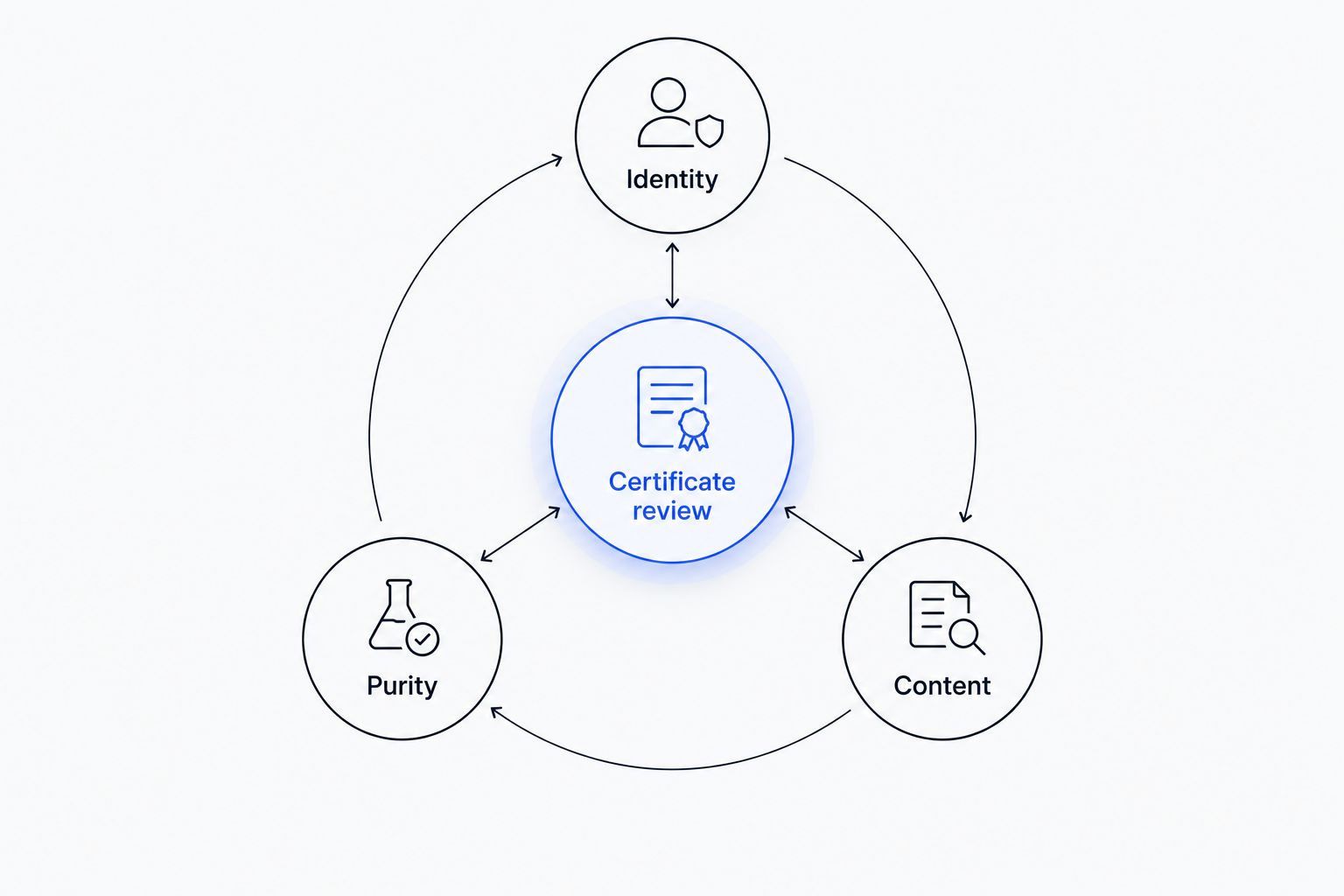
Consider 2 analytical methods—liquid chromatography and mass spectrometry—as complementary sources of evidence, not interchangeable stamps of quality. Neither automatically proves receptor activity. The laboratory's method requirements determine which additional measurements are necessary.
An acceptance record should also preserve the batch identifier and the document version. If a result cannot be connected to the material used, it cannot explain that material's behavior.
Match receptor evidence to the experiment
Metabolic pathway research often groups compounds by receptor targets. That classification is useful, but a shared target does not make different molecules experimentally equivalent.
The primary literature describes semaglutide as a GLP-1 receptor agonist, tirzepatide as a GIP and GLP-1 receptor agonist, and retatrutide as a GIP, GLP-1, and glucagon receptor agonist.[^1][^2][^3] These are molecular distinctions, not permissions for any particular application of a supplied reagent.
Keep 3 evidence checkpoints separate:
- Chemical characterization: Evidence about the material's molecular identity and composition.
- Receptor response: Evidence about signaling under a defined assay system.
- Experimental relevance: Evidence that the material and assay address the stated research question.
Receptor binding and receptor activation also describe different measurements. Binding concerns interaction with a receptor; activation concerns the resulting functional response. A downstream signaling measurement must be interpreted within its cellular environment.
In a 2026 comparison, published receptor findings should guide the questions asked of a material—not be transferred automatically to an uncharacterized vial. A literature compound and a supplied batch are separate objects of evidence.
How this ranking works
The ranking follows experimental purpose: focused catalog research, custom molecular design, analytical calibration, then broad reagent requirements. It does not assign unsupported scores for purity, service, or laboratory outcomes.
The criteria are molecular identity, traceability, purity profiles, peptide content, functional relevance, and research scope. Each supplier model occupies a distinct use case; there is no evidence-based reason to declare one model universally best.
For 2026, the strongest supplier decision is the one that survives a batch-level acceptance review. A recognizable name cannot resolve a missing structural specification or an unexplained analytical result.
Which supplier model should a laboratory choose?
For an existing GLP-focused catalog compound, a specialized RUO supplier is the relevant starting category. For a new sequence, custom synthesis is the better-matched model. For calibration, select a reference material whose documented purpose matches the measurement.
A broad reagent supplier fits projects with several material categories, provided that peptide evaluation remains material-specific. The default decision is therefore simple: match the supplier model to the experiment, then evaluate the exact batch.
FAQ
What are the best peptide suppliers for metabolic research studies?
The best peptide suppliers for metabolic research studies are those whose materials and documentation match the intended in vitro experiment. Compare molecular identity, batch traceability, purity profiles, peptide content, and functional evidence rather than relying on catalog breadth.
Is a specialist peptide supplier better than a broad reagent supplier?
A specialist supplier is better matched to a focused catalog requirement, while a broad supplier fits multi-reagent projects. Neither model establishes the quality of a particular peptide batch without material-specific evidence.
Does research-use-only labeling prove peptide purity?
No. Research-use-only labeling states an intended use category, not an analytical result. Purity requires an identified method and a result connected to the relevant batch.
Is a Certificate of Analysis enough for receptor research?
A Certificate of Analysis alone does not establish suitability for receptor research. Chemical identity, composition, and assay-specific functional requirements need separate assessment.
Does chromatographic purity equal peptide content?
No. Chromatographic purity and peptide content describe different quantities. Peak-area results must be interpreted within the analytical method and do not automatically establish the amount of peptide present.
When is custom peptide synthesis the right supplier model?
Custom synthesis is the appropriate model when the experiment requires a defined sequence or modification not covered by a suitable catalog material. The resulting material still requires identity confirmation and characterization.
Can a reference peptide serve as a receptor assay control?
Only when its documented properties support that assay role. A material characterized for chemical identification or calibration does not automatically have established receptor activity.
One last thing
A purity result is not a complete identity statement. A chemically pure material can still be the wrong sequence, modification pattern, or chemical form for the experiment. Resolve identity before interpreting biological response; otherwise, an apparently precise assay can answer the wrong molecular question.
Scientific references
These primary papers support the molecular and receptor distinctions discussed above. They do not establish the characteristics of any supplier's batch.
[^1]: Lau et al., Discovery of the Once-Weekly Glucagon-Like Peptide-1 (GLP-1) Analogue Semaglutide. Journal of Medicinal Chemistry. Scope: molecular design and characterization of semaglutide.
[^2]: Willard et al., LY3298176, a novel dual GIP and GLP-1 receptor agonist for the treatment of type 2 diabetes mellitus: From discovery to clinical proof of concept. JCI Insight. Scope used here: molecular identity and receptor pharmacology, not clinical findings.
[^3]: Coskun et al., LY3437943, a novel triple GIP, GLP-1, and glucagon receptor agonist for glycemic control and weight loss: From discovery to clinical proof of concept. Cell Metabolism. Scope used here: molecular identity and receptor characterization, not clinical findings.
Related guides
- GLP-1 impurity characterization for research
- GLP-1 peptide stability research
- How to study GLP-1 receptor binding in the lab
All products available on glp-123.com are supplied strictly for laboratory research and development purposes only. These materials are not intended for human or animal consumption, medical use, diagnostic procedures, or therapeutic applications. Any ancillary items included with a product, such as Bacteriostatic Water or mixing syringes, are provided solely as research-use accessories to support laboratory preparation and reconstitution procedures. Syringes are not intended for injection, administration, or use involving humans or animals. The statements and content on this website have not been evaluated by the U.S. Food and Drug Administration (FDA). The products offered are not designed to diagnose, treat, cure, or prevent any disease or medical condition. GLP-123 operates solely as a chemical supplier for research professionals and accredited institutions and is not a pharmacy, compounding facility, or outsourcing establishment under Sections 503A or 503B of the Federal Food, Drug, and Cosmetic Act. By purchasing from GLP-123, you confirm that all products will be used in compliance with applicable laws and laboratory safety guidelines.
Originally published on glp-123.com. This library mirrors the guide for easier reading. Products mentioned are for laboratory research only.
View original


