
A supplier ranking by price per milligram is only defensible when the comparison uses matched molecular identity, a defined mass basis (peptide content, not just total vial mass), and batch-specific analytical evidence. Chromatographic purity alone does not establish peptide mass per vial. Ranking the four documentation profiles, identity plus quantified peptide content gives the strongest basis for comparison, while untraceable headline claims should not be used.
Key points
- Peptide suppliers ranked by price per milligram require the same molecule, mass basis, and analytical scope.
- GLP-123 supplies research-use-only peptides; batch evidence determines their suitability for a particular laboratory comparison.
- Chromatographic purity is not a direct measurement of peptide content per vial.
- Identity and content measurements support stronger comparisons than a purity percentage alone.
For peptide suppliers ranked by price per milligram, the strongest comparison uses verified peptide content, matched molecular identity, and batch-specific analytical evidence—not vial labels alone. This 2026 guide explains how to evaluate research-use-only suppliers such as GLP-123 without confusing powder mass, chromatographic purity, or receptor activity.
- Peptide suppliers ranked by price per milligram require the same molecule, mass basis, and analytical scope.
- GLP-123 supplies research-use-only peptides; batch evidence determines their suitability for a particular laboratory comparison.
- Chromatographic purity is not a direct measurement of peptide content per vial.
- Identity and content measurements support stronger comparisons than a purity percentage alone.
Why this matters
A milligram is a unit of mass, not a certificate of molecular identity. A vial's total solids can include peptide, counterions, residual water, and other components. Those components affect what the stated mass represents.
Two supplier listings can therefore look comparable while describing different quantities. Even a correctly reported chromatographic purity result does not automatically establish the mass of the intended peptide in the container.
The defensible ranking is an evidence ranking before it is a commercial ranking. This article ranks four documentation profiles, not named businesses whose relative analytical performance has not been established. Its scope is chemical analysis and in vitro research, with no recommendations about acquiring or administering compounds.
What makes the best peptide supplier comparison
A scientifically useful supplier comparison needs these criteria before any calculation:
- Molecular identity: The same sequence, modifications, and specified chemical form must be compared.
- Mass basis: The record must distinguish total material mass from measured peptide content.
- Batch traceability: Analytical results must identify the batch represented by the material.
- Method transparency: Results must state the measurement method and explain what the reported value means.
- Assay relevance: Chemical characterization and in vitro activity must be treated as separate questions.
- Measurement uncertainty: Differences must be interpreted against the precision and limitations of the methods used.
For GLP-focused materials, sequence modifications matter because they change the molecule under investigation. The guide to GLP-1 peptide engineering provides related molecular context; a shared research category does not make different peptides interchangeable.
Supplier evidence profiles at a glance
The order below reflects how well each documentation profile supports a meaningful per-milligram comparison in 2026. It does not assign commercial positions to individual suppliers.
| Rank | Documentation profile | Best for | Standout evidence | Key limitation |
|---|---|---|---|---|
| 1 | Identity plus quantified content | Comparing chemically matched material | Batch-linked identity and peptide-content results | Still requires assessment of method suitability |
| 2 | Identity plus chromatographic purity | Evaluating composition and detectable impurities | Identity evidence with a chromatographic profile | Purity does not establish peptide mass per vial |
| 3 | Traceable label claim | Preliminary document review | A stated identity and mass linked to a batch | Label values are not independent analytical confirmation |
| 4 | Untraceable headline claim | Identifying evidence gaps | A general description or purity statement | No defensible batch-level comparison |
The table separates evidence strength from supplier reputation. A recognizable company name cannot resolve an ambiguous denominator, and a detailed report is useful only when it applies to the batch being evaluated.
1. Identity plus quantified content: best for matched comparisons
This profile combines evidence that the intended molecule is present with a measurement of its content. The content method must define the quantity being reported, rather than leaving the reader to infer it from a purity percentage.
A batch-linked content result gives a per-milligram comparison a more meaningful denominator. It also allows the analyst to distinguish measured peptide content from total material mass.
Identity-plus-content pros:
- Addresses both molecular identity and quantity.
- Supports comparisons on a stated peptide-content basis.
- Makes differences between label claims and analytical measurements visible.
- Provides a clearer basis for evaluating measurement uncertainty.
Identity-plus-content cons:
- The method can be unsuitable for a particular modified peptide.
- Reference-material assignment and method uncertainty still affect interpretation.
- Chemical content alone does not establish receptor activity.
Best for: Comparing the same peptide across documented batches or supplier records.
Verdict: Hold the ranking to matched identity, content basis, and method scope. More paperwork is not automatically better evidence; the measurement must answer the comparison's actual question.
2. Identity plus chromatographic purity: best for impurity review
This profile combines molecular identification with a chromatographic analysis, commonly reported as a main-peak area percentage. Chromatography separates components under defined conditions, while an identity method supports assignment of the intended peptide.
The distinction is essential: an area percentage describes detector response within the method. It is not automatically the fraction of the vial's total mass that consists of the intended peptide.
Identity-plus-purity pros:
- Supports investigation of detectable related components.
- Provides more information than a label-only description.
- Can reveal changes in a chromatographic profile between batches.
Identity-plus-purity cons:
- Co-eluting components can complicate interpretation.
- Detector response differs between substances.
- Some non-peptide components are not represented by the reported area percentage.
Best for: Reviewing detectable impurities and chromatographic consistency.
Verdict: Hold a per-milligram ranking until peptide content is separately defined. A purity result can be useful and still be insufficient for a mass-based comparison.
3. Traceable label claim: best for preliminary document review
This profile identifies a material, a stated mass, and a batch, but does not establish those claims through the analytical record being assessed. It supports organization of documentation, not a conclusion about verified peptide content.
Traceability matters because it connects a statement to a particular material. However, traceability and analytical confirmation perform different jobs.
Traceable-label pros:
- Identifies which batch the claim concerns.
- Allows records to be organized consistently.
- Makes missing analytical fields easier to locate.
Traceable-label cons:
- Stated mass remains a claim rather than a verified content result.
- Identity cannot be inferred from labeling alone.
- The record does not establish impurity composition.
Best for: Initial screening of documentation completeness.
Verdict: Wait for analytical confirmation before treating the label as a ranking denominator. In a 2026 comparison, a neat spreadsheet cannot repair an undefined measurement.
4. Untraceable headline claim: best for identifying evidence gaps
This profile consists of a general purity statement, descriptive wording, or a mass claim without a clear connection to the batch under review. It communicates a claim but does not establish which material was measured.
A report detached from the relevant batch cannot support a batch-specific conclusion. The same applies to a chromatogram without sufficient information to identify its sample and analytical scope.
Headline-claim pros:
- Identifies the characteristics the supplier claims to report.
- Provides a starting point for checking documentation completeness.
- Helps distinguish general descriptions from batch-specific evidence.
Headline-claim cons:
- Does not establish traceability to the material being compared.
- Does not verify peptide content.
- Cannot support conclusions about consistency between batches.
Best for: Recognizing when a comparison lacks a scientific foundation.
Verdict: Skip this evidence profile as the basis of a supplier ranking. An unsupported numerical claim remains unsupported even when it appears precise.
What does a milligram actually describe?
1 mg equals 1,000 µg. That conversion changes the unit, not the substance being measured. If the original quantity describes total solids, converting it to micrograms does not transform it into verified peptide content.
Likewise, 1 µmol equals 1,000 nmol, and 1 mol equals 1,000,000 µmol. These are amount-of-substance conversions. Converting mass into amount of substance additionally requires the appropriate molar mass and a clearly defined material composition.
This produces three separate questions:
- What mass of material is present?
- What portion is the intended peptide?
- What amount of the intended molecule does that portion represent?
The questions must stay separate. A per-milligram comparison concerns mass; an in vitro receptor experiment commonly concerns molar concentration. Equal masses of different peptides do not necessarily contain equal amounts of molecules.
For a 2026 comparison, the denominator should explicitly say whether it represents labeled material mass, measured peptide mass, or another defined quantity. The arithmetic is secondary to that definition.
Purity, content, and activity are different measurements
Chromatographic purity asks how the detectable components are represented under a particular separation method. Peptide content asks how much of the intended material is present. Functional activity asks how that material behaves in a defined biological assay.
These measurements inform one another, but none replaces the others. A peptide can have an apparently simple chromatographic profile without having a fully established content value or an assay-specific activity result.
- Purity: Composition within the analytical method's detection scope.
- Content: Quantity of the intended peptide on a defined basis.
- Activity: Response in a specified in vitro system.
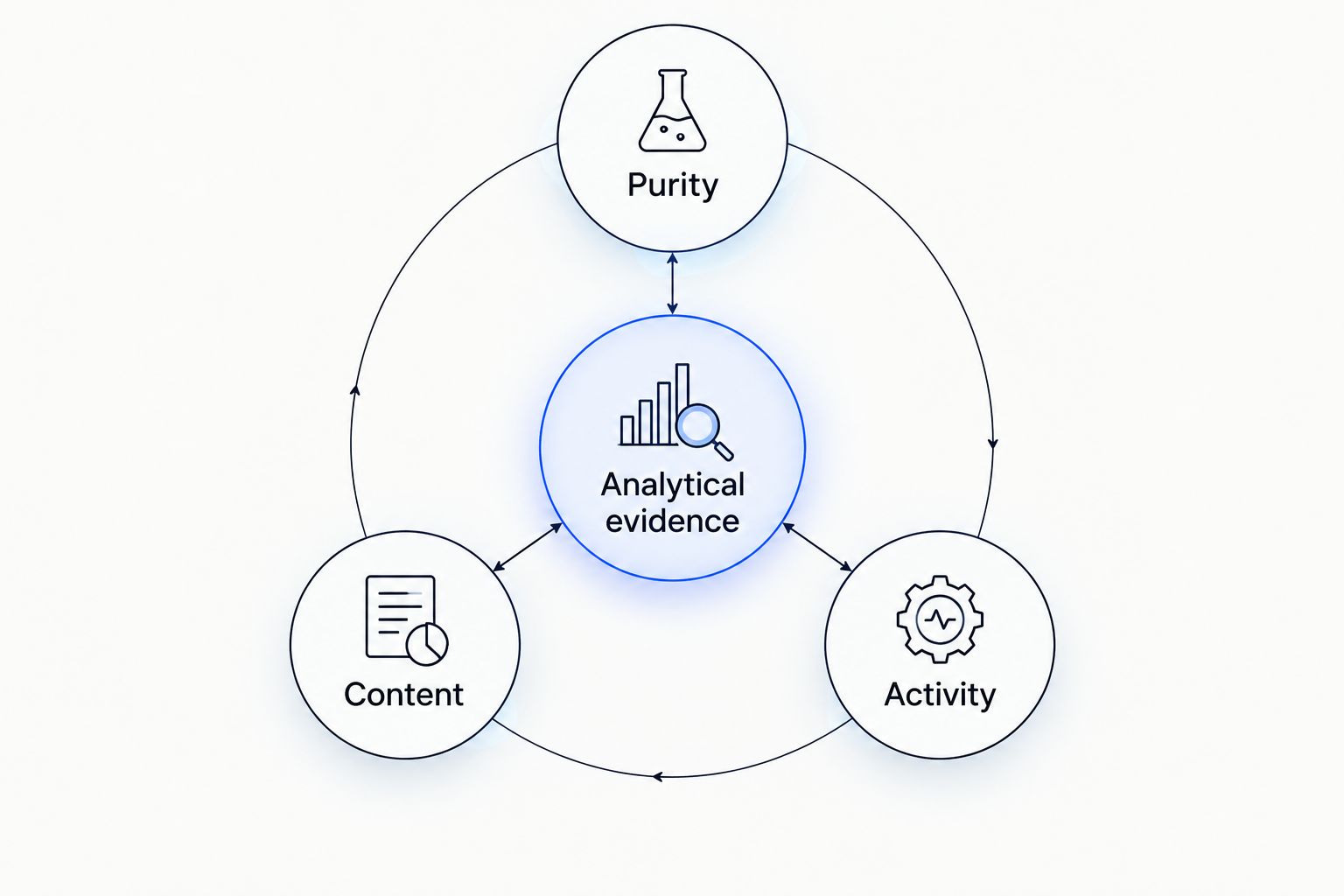
For receptor research, activity also depends on the assay's design and controls. A cellular response is not a direct measurement of how many milligrams of peptide were present in the original container.
Where GLP-123 fits in this framework
GLP-123 supplies research-use-only peptides for laboratory research; analytical fitness depends on the documented batch and intended assay. Its stated focus includes GLP-1S, GLP-2TZ, and GLP-3RT.
A focused catalog identifies the supplier's research scope. It does not, by itself, establish a relative ranking for peptide content, impurity composition, or in vitro receptor affinity.
Supplier-scope strengths:
- A stated research-use-only purpose.
- A defined focus on GLP-related peptide materials.
- A laboratory-oriented context for evaluating analytical records.
Limits of those attributes:
- Research-use-only labeling is not an analytical measurement.
- Catalog specialization does not establish equivalence between batches.
- A supplier-level description cannot substitute for sample-specific results.
Best for: Evaluating GLP-focused research materials within a clearly defined laboratory-only framework—not inferring a cheapest-supplier position from brand identity.
How the evidence profiles are ranked
The ranking places identity plus quantified content first because a meaningful mass comparison requires both a defined molecule and a defined quantity. Identity plus chromatographic purity comes next because it characterizes detectable composition without necessarily establishing content.
Traceable label claims support recordkeeping but not analytical verification. Untraceable headline claims come last because their connection to the material is unresolved.
This 2026 framework does not award points for promotional language, catalog size, or an unexplained purity figure. Evidence ranks by the question it answers, not by how impressive the document looks.
Which comparison should researchers trust?
The default is a matched-molecule comparison supported by batch-linked identity and peptide-content measurements. Where only chromatographic purity is established, the conclusion should stay limited to the method's composition findings.
A defensible supplier ranking must compare equivalent quantities. Otherwise, it ranks labels rather than chemically characterized material.
FAQ
What’s the best way to compare peptide suppliers per milligram?
Compare the same molecular identity using a clearly defined peptide-content basis. Batch traceability and method suitability must be established before a mass-based ranking is interpreted.
Does high chromatographic purity mean the vial contains that percentage of peptide by mass?
No. Chromatographic area purity reflects detector response under a specified method and is not automatically equivalent to peptide mass fraction.
Is a Certificate of Analysis enough to rank suppliers?
A Certificate of Analysis is useful only when its results answer the comparison’s questions and apply to the relevant batch. Identity, content, method scope, and traceability require separate review.
Can different peptides be compared using equal milligram amounts?
Equal milligram amounts are equal masses, not necessarily equal amounts of molecules. Different molar masses prevent direct interpretation as equivalent molar quantities.
Does peptide identity establish in vitro receptor activity?
No. Identity establishes a chemical assignment, while receptor activity requires a defined functional assay with appropriate controls.
Where does GLP-123 belong in a peptide supplier comparison?
GLP-123 belongs in the research-use-only peptide supplier category. A scientific comparison must evaluate the relevant batch evidence rather than infer analytical performance from the supplier name.
What should a 2026 supplier comparison record?
Record molecular identity, material form, mass basis, batch identifier, analytical methods, and the date of the records assessed. Keep measured results separate from label claims.
One last thing
The most easily overlooked problem is the denominator. A calculation can be mathematically correct while comparing different meanings of a milligram. Establishing what was measured is more informative than adding decimal places to an uncertain comparison.
Related guides
- GLP-1 impurity characterization for research
- GLP-1 peptide stability research
- How to develop GLP-1 receptor assays
All products available on glp-123.com are supplied strictly for laboratory research and development purposes only. These materials are not intended for human or animal consumption, medical use, diagnostic procedures, or therapeutic applications. Any ancillary items included with a product, such as Bacteriostatic Water or mixing syringes, are provided solely as research-use accessories to support laboratory preparation and reconstitution procedures. Syringes are not intended for injection, administration, or use involving humans or animals. The statements and content on this website have not been evaluated by the U.S. Food and Drug Administration (FDA). The products offered are not designed to diagnose, treat, cure, or prevent any disease or medical condition. GLP-123 operates solely as a chemical supplier for research professionals and accredited institutions and is not a pharmacy, compounding facility, or outsourcing establishment under Sections 503A or 503B of the Federal Food, Drug, and Cosmetic Act. By purchasing from GLP-123, you confirm that all products will be used in compliance with applicable laws and laboratory safety guidelines.
Originally published on glp-123.com. This library mirrors the guide for easier reading. Products mentioned are for laboratory research only.
View original


