
GLP-1 beta-arrestin signaling is the recruitment of beta-arrestin-1 and beta-arrestin-2 to the activated GLP-1 receptor, a pathway that runs alongside Gs-cAMP signaling and can independently drive ERK1/2 phosphorylation in laboratory assays. Transient ERK activity points to G-protein coupling, while sustained ERK activity after internalization points to arrestin scaffolding.
Key points
- GLP-1 beta-arrestin signaling runs alongside Gs-cAMP activation and drives a separate ERK1/2 MAPK cascade in vitro.
- BRET and enzyme fragment complementation assays are the standard bench methods for measuring arrestin recruitment in 2026 research.
- Biased agonism data requires matched peptide purity and receptor expression controls, not just potency comparisons.
- Transient ERK activity points to G-protein coupling; sustained ERK activity after internalization points to arrestin scaffolding.
GLP-1 beta-arrestin signaling describes the recruitment of beta-arrestin-1 and beta-arrestin-2 to the activated GLP-1 receptor, a parallel pathway that receptor pharmacology researchers track alongside Gs-cAMP activation to separate transient G-protein output from arrestin-scaffolded ERK1/2 activation in laboratory assays.
- GLP-1 beta-arrestin signaling runs alongside Gs-cAMP activation and drives a separate ERK1/2 MAPK cascade in vitro.
- BRET and enzyme fragment complementation assays are the standard bench methods for measuring arrestin recruitment in 2026 research.
- Biased agonism data requires matched peptide purity and receptor expression controls, not just potency comparisons.
- Transient ERK activity points to G-protein coupling; sustained ERK activity after internalization points to arrestin scaffolding.
Why this matters
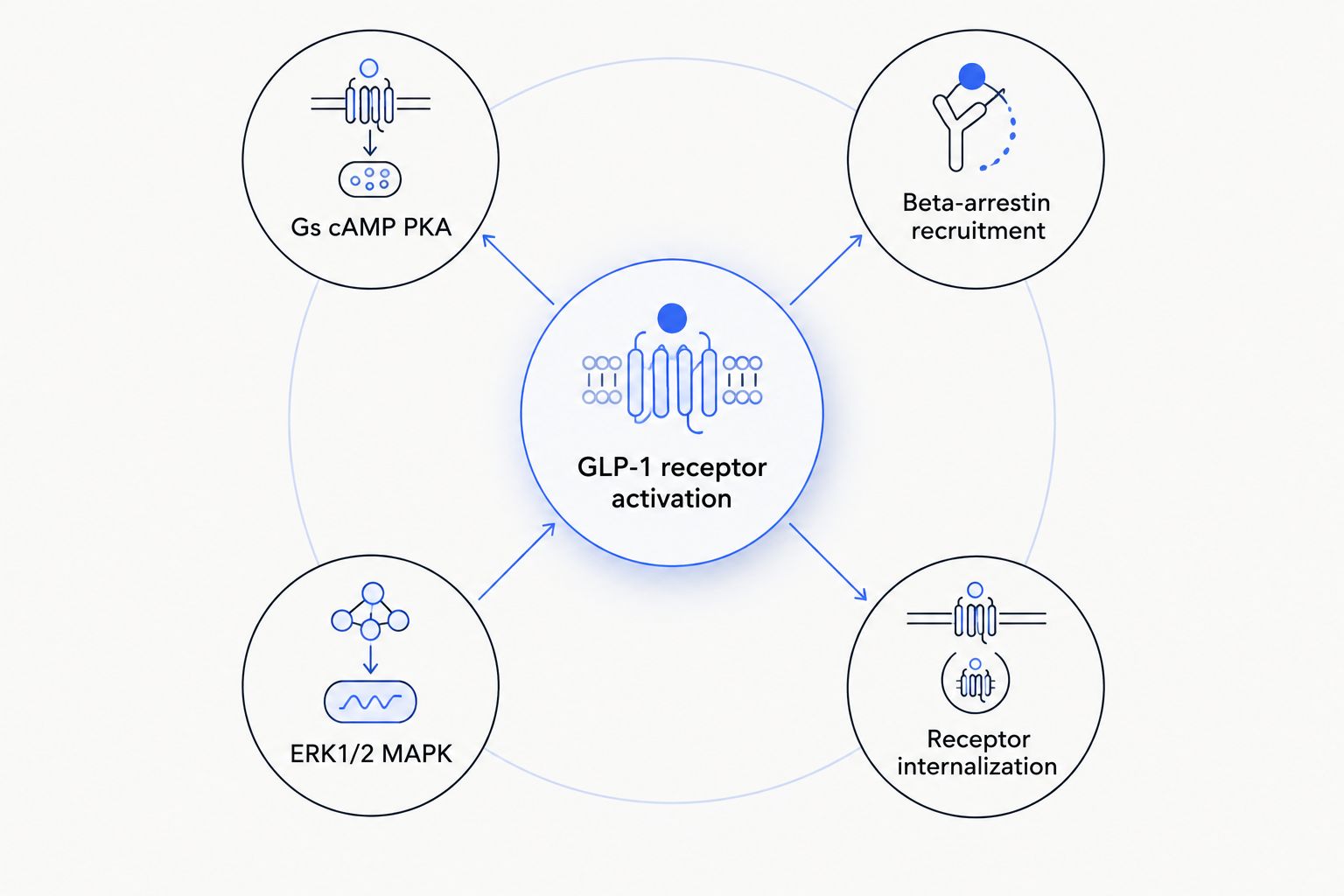
The GLP-1 receptor is a class B G-protein-coupled receptor built from 463 amino acids in its human sequence, and it does not signal through one channel. Agonist binding triggers Gs-coupled cAMP/PKA output, but it also recruits beta-arrestin, which pulls the receptor into internalization and, independently, scaffolds its own ERK1/2 phosphorylation cascade.
That second arm is where biased agonism research lives. Two ligands can show identical potency at the cAMP readout and diverge sharply once beta-arrestin recruitment and ERK1/2 kinetics are measured, and this divergence is the basis for biased agonism work happening across receptor pharmacology labs in 2026.
Why GLP-1 beta-arrestin signaling matters for receptor pharmacology researchers
Receptor pharmacology researchers are not asking whether a peptide activates the GLP-1 receptor. They are asking which pathway it activates, how strongly, and for how long. A test substance that recruits beta-arrestin efficiently but couples weakly to Gs will behave differently in a cell-based assay than one that does the reverse, even at matched molar concentration.
This distinction drives three practical needs specific to this segment:
- Assay panels that report more than one endpoint, since cAMP alone hides arrestin-mediated effects
- Time-resolved sampling, because G-protein and arrestin-driven ERK signals resolve on different timescales
- Reagent-level control, since purity and receptor expression variance can masquerade as pathway bias
How receptor pharmacology researchers study GLP-1 beta-arrestin and ERK signaling
Map the receptor's parallel signaling arms before designing an assay
Start by laying out every arm the GLP-1 receptor can activate, not just the one the assay kit measures by default.
- Gs-cAMP-PKA arm, the canonical readout in most commercial kits
- Beta-arrestin-1 and beta-arrestin-2 recruitment arm
- ERK1/2 MAPK phosphorylation arm, fed by both G-protein and arrestin routes
- Receptor internalization and trafficking arm, downstream of arrestin binding
Choose an assay platform for beta-arrestin recruitment
The manual bench approach does not require a proprietary kit. Recruitment can be measured with:
- BRET-based recruitment assays using tagged receptor and arrestin constructs
- Enzyme fragment complementation, where recruitment reconstitutes an enzyme signal
- GFP-tagged arrestin translocation tracked by fluorescence microscopy
- Split-luciferase complementation for a lower-cost bioluminescent readout
Quantify ERK1/2 phosphorylation kinetics
ERK1/2 phosphorylation is where transient G-protein signaling and sustained arrestin-scaffolded signaling actually separate on a plot.
- Western blot with phospho-specific ERK1/2 antibodies for a direct, low-throughput readout
- Phospho-flow cytometry for single-cell resolution across a cellular environment
- AlphaLISA or similar bead-based phospho-ERK kits for higher throughput
- Multi-timepoint sampling across at least five to ten minutes intervals, not a single snapshot
Control reagent variability before drawing conclusions on bias
This is where reagent-level discipline stops being a formality and starts determining whether the data means anything. Before comparing pathway output across test substances, confirm the inputs are actually comparable.
- Verify peptide purity against a batch-specific certificate of analysis rather than assuming uniformity across lots
- Confirm receptor expression density is consistent across the cell line passages used
- Standardize reconstitution buffer and reagent volume across every replicate well
- Log the molar concentration prepared for each test substance at the point of use
Distinguish biased agonism from a plain potency difference
A ligand that looks "stronger" on cAMP alone is not automatically biased. Bias only shows up once multiple pathways are compared on equal footing.
- Calculate transduction coefficients across each pathway readout
- Compare Emax and EC50 at cAMP, arrestin recruitment, and ERK1/2 separately
- Correct for receptor density differences between assay runs
- Run reference ligands in parallel to normalize the comparison
Document and archive assay conditions for reproducibility
Signaling bias data that cannot be reproduced by a second technician is not usable data.
- Record cell line passage number for every assay run
- Log the reconstitution and lyophilization batch used for each test substance
- Track storage temperature history from receipt to reagent volume preparation
- Timestamp molar concentration prep alongside the assay run date
Assay platforms for measuring beta-arrestin recruitment and ERK signaling
| Assay platform | Best for | Key limitation |
|---|---|---|
| BRET-based recruitment assay | Real-time kinetics of beta-arrestin recruitment | Needs transfected reporter constructs |
| Enzyme fragment complementation | Higher-throughput screening of biased ligands | Signal depends on fragment orientation |
| Western blot for phospho-ERK1/2 | Confirming pathway activation with antibody specificity | Low throughput, semi-quantitative |
| Phospho-flow cytometry | Single-cell resolution of ERK activation | Requires cytometer access and fixation optimization |
“Transient ERK activity points to G-protein coupling; sustained ERK activity after receptor internalization points to beta-arrestin scaffolding.”
Common mistakes receptor pharmacology researchers make
- Treating cAMP output as the whole story. Arrestin-mediated ERK signaling runs independently and gets missed entirely on a single-endpoint assay.
- Sampling ERK phosphorylation once. A single timepoint cannot separate a transient G-protein spike from sustained arrestin-driven signaling.
- Comparing agonist bias without normalizing receptor density. Expression differences between cell line passages get misread as pharmacological bias.
- Assuming batch-to-batch peptide purity is constant. Skipping the certificate of analysis on each lot introduces variance that looks like biology but isn't.
- Mixing reconstitution protocols between replicate wells. Inconsistent reagent volume and molar concentration prep drift the dose-response curve before the assay even runs.
FAQ
What is GLP-1 beta-arrestin signaling?
It is the recruitment of beta-arrestin-1 and beta-arrestin-2 to the activated GLP-1 receptor, a pathway that runs alongside Gs-cAMP signaling and independently drives ERK1/2 MAPK phosphorylation in laboratory assays.
How does beta-arrestin recruitment differ from Gs-cAMP signaling at the GLP-1 receptor?
Gs-cAMP signaling activates PKA through G-protein coupling, while beta-arrestin recruitment drives receptor internalization and a separate, often more sustained, ERK1/2 phosphorylation cascade.
Why does ERK1/2 phosphorylation matter in GLP-1 receptor research?
ERK1/2 phosphorylation kinetics reveal whether a signal is G-protein-driven or arrestin-scaffolded, which is the core data point behind biased agonism comparisons.
What assay is best for measuring biased agonism at the GLP-1 receptor?
BRET-based recruitment assays give real-time kinetics for arrestin recruitment, while enzyme fragment complementation offers higher throughput for screening multiple ligands.
How many amino acids make up the human GLP-1 receptor?
The human GLP-1 receptor sequence is 463 amino acids long, structured as a class B GPCR with seven transmembrane domains.
Can beta-arrestin-1 and beta-arrestin-2 be distinguished in the same assay?
Yes, isoform-specific tagged constructs or antibodies can separate beta-arrestin-1 from beta-arrestin-2 recruitment within the same BRET or fluorescence-based assay design.
What causes variability in ERK signaling data between labs?
Mismatched receptor expression density, inconsistent reconstitution protocols, and unverified peptide purity across batches are the most common sources of variance between labs.
Is GLP-1 beta-arrestin signaling relevant to receptor desensitization research?
Yes, beta-arrestin recruitment is the step that initiates receptor internalization, making it directly relevant to any desensitization study downstream of initial activation.
One last thing
Most bias comparisons stop at phosphorylation levels and never check subcellular localization. Arrestin-scaffolded ERK activity tends to stay cytoplasmic near internalized receptor complexes, while G-protein-driven ERK activity more readily translocates toward the nucleus. A phospho-ERK blot alone cannot tell that difference apart; a fractionation step or imaging readout can, and it's the detail that separates a surface-level bias claim from one that holds up under review in 2026.
Related guides
All products available on glp-123.com are supplied strictly for laboratory research and development purposes only. These materials are not intended for human or animal consumption, medical use, diagnostic procedures, or therapeutic applications. Any ancillary items included with a product, such as Bacteriostatic Water or mixing syringes, are provided solely as research-use accessories to support laboratory preparation and reconstitution procedures. Syringes are not intended for injection, administration, or use involving humans or animals. The statements and content on this website have not been evaluated by the U.S. Food and Drug Administration (FDA). The products offered are not designed to diagnose, treat, cure, or prevent any disease or medical condition. GLP-123 operates solely as a chemical supplier for research professionals and accredited institutions and is not a pharmacy, compounding facility, or outsourcing establishment under Sections 503A or 503B of the Federal Food, Drug, and Cosmetic Act. By purchasing from GLP-123, you confirm that all products will be used in compliance with applicable laws and laboratory safety guidelines.
Originally published on glp-123.com. This library mirrors the guide for easier reading. Products mentioned are for laboratory research only.
View original


