
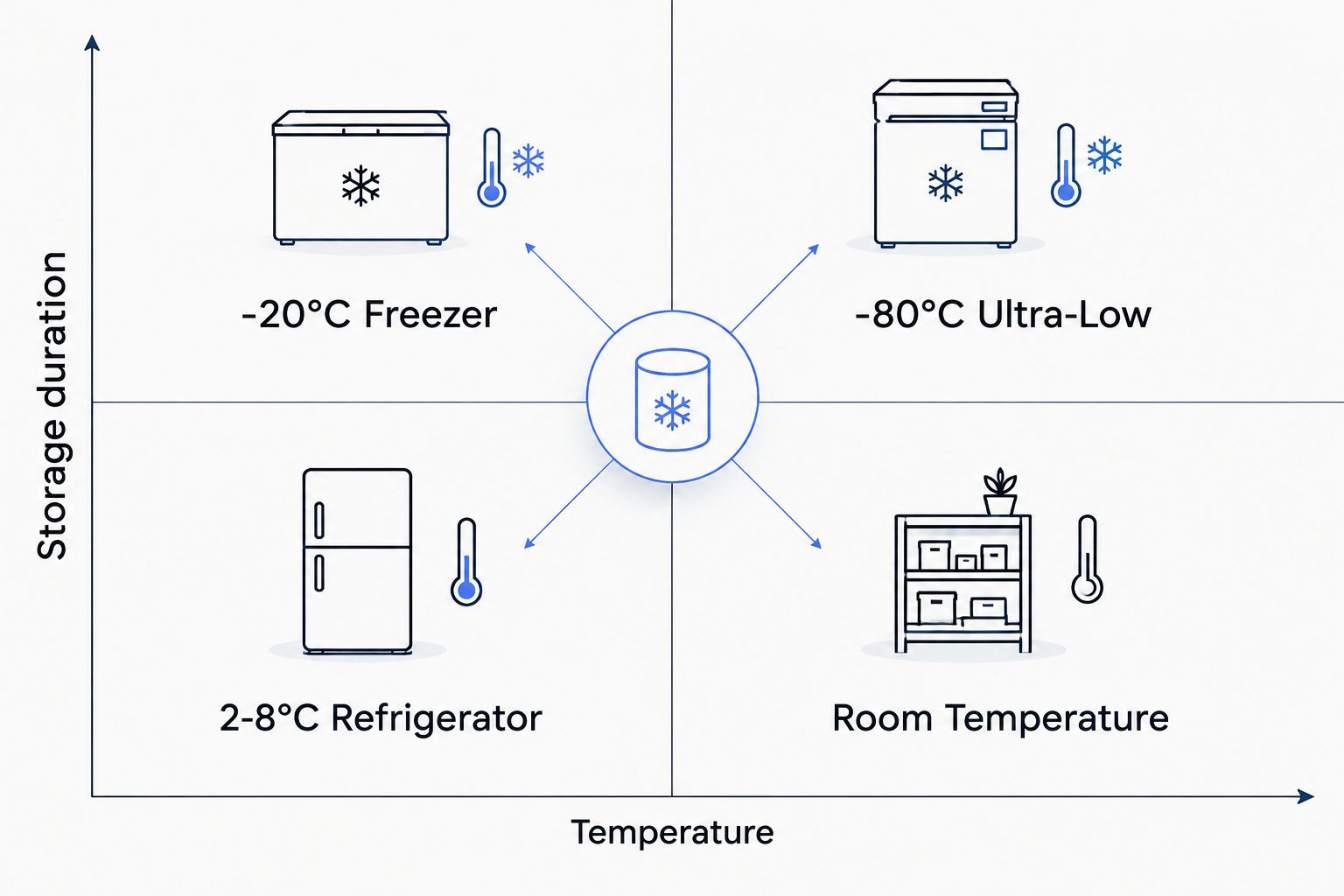
Store lyophilized GLP-2TZ in a sealed, desiccated vial at -20°C, shielded from light, as the default for most lab timelines. Use -80°C only for multi-year archival stock, 2-8°C only for vials in active weekly use, and room-temperature storage only for transit windows of a few days.
Key points
- Best overall for the best storage conditions for lyophilized GLP-2TZ peptides: a sealed, desiccated -20°C freezer shielded from light.
- Refrigeration at 2-8°C suits vials accessed weekly but degrades lyophilized GLP-2TZ faster than a dedicated freezer over months.
- A -80°C ultra-low freezer extends archival stability for GLP-2TZ research stock held across multiple years.
- Room-temperature desiccated storage is a transit condition only, never a long-term plan for lyophilized peptide vials.
Lyophilized GLP-2TZ research peptide degrades fastest when temperature, moisture, and light work against it, not because the compound itself is unstable. This guide ranks the storage conditions that keep a lyophilized GLP-2TZ vial closest to its Certificate of Analysis specification for the longest window, and flags the setups that quietly shorten usable lab stock in 2026.
- Best overall for the best storage conditions for lyophilized GLP-2TZ peptides: a sealed, desiccated -20°C freezer shielded from light.
- Refrigeration at 2-8°C suits vials accessed weekly but degrades lyophilized GLP-2TZ faster than a dedicated freezer over months.
- A -80°C ultra-low freezer extends archival stability for GLP-2TZ research stock held across multiple years.
- Room-temperature desiccated storage is a transit condition only, never a long-term plan for lyophilized peptide vials.
Why this matters
A lyophilized peptide is a freeze-dried cake, not a liquid, which is exactly why it tolerates storage better than a reconstituted solution. Moisture uptake, heat, and UV exposure each drive separate degradation pathways in a research peptide: hydrolysis, oxidation, and aggregation. Get the storage condition wrong and a batch that passed GLP-2TZ research peptide purity testing at receipt can show a different HPLC profile six months later.
The conditions below aren't interchangeable substitutes. Each one trades off temperature stability, humidity control, and access convenience differently, and the right pick depends on how often a lab actually opens the vial.
What makes the best storage condition
- Temperature stability — a storage unit that holds a consistent set point without freeze-thaw cycling on the vial itself
- Moisture exclusion — desiccant packs or silica gel inside the storage container, not just a sealed cap
- Light protection — amber glass, foil wrap, or an opaque storage box, since UV exposure accelerates oxidation
- Container closure integrity — a stopper and crimp seal that hasn't been repeatedly punctured
- Access frequency match — matching the storage tier to how often the vial actually leaves the unit
At a glance: storage conditions compared
| Storage condition | Best for | Standard temperature range | Key limitation |
|---|---|---|---|
| -20°C freezer, desiccated, dark | Long-term lyophilized GLP-2TZ stock | -20°C | Freezer power interruptions compromise the whole batch |
| 2-8°C refrigeration | Active, high-turnover working vials | 2-8°C | Faster degradation than freezer storage over months |
| -80°C ultra-low freezer | Multi-year archival research stock | -80°C | Higher equipment cost, overkill for short projects |
| Room-temperature, desiccated | Short transit or handling windows | 15-25°C | Not suitable as a storage plan past a few days |
1. -20°C freezer storage: best for long-term lyophilized GLP-2TZ stock
A standard lab freezer holding a steady -20°C, with the vial kept in its original sealed packaging alongside a desiccant pack, is the default recommendation for lyophilized GLP-2TZ stock intended to last months rather than days. Wrapping the vial in foil or storing it inside an opaque box adds a light barrier that the original packaging sometimes lacks. Choosing the right lab freezer matters more than most labs assume, since frost-free freezers cycle temperature during defrost and that cycling is exactly what a lyophilized cake doesn't want.
-20°C freezer pros:
- Widely available equipment, no specialized purchase needed
- Stable temperature range for extended lyophilized storage
- Compatible with standard vial boxes and desiccant packs
-20°C freezer pros (continued):
- Works for both GLP-2TZ and other lyophilized research peptides stored side by side
-20°C freezer cons:
- A power outage or door left ajar compromises the whole shelf, not just one vial
- Frost-free models introduce freeze-thaw cycling near the door if placement isn't planned
Best for: labs holding lyophilized GLP-2TZ for weeks to a couple of years between uses.
Verdict: Recommended as the default condition.
2. 2-8°C refrigeration: best for active, high-turnover working vials
A standard lab refrigerator set to 2-8°C works for vials that get pulled out and handled regularly, where the trip in and out of a freezer would introduce more condensation risk than the fridge's slightly warmer set point causes on its own. This tier suits an actively running study, not archived stock.
2-8°C refrigeration pros:
- Fast, low-friction access for daily or weekly lab work
- Lower condensation risk on the vial than frequent freezer trips
- Adequate for short project timelines measured in weeks
2-8°C refrigeration cons:
- Degrades lyophilized GLP-2TZ faster than a -20°C freezer over a multi-month horizon
- Shared fridge space raises contamination and light-exposure risk without a dedicated dark box
Best for: vials in active use during a running protocol, not long-term inventory.
Verdict: Situational — fine for weeks, not for a full research cycle.
3. -80°C ultra-low freezer: best for multi-year archival research stock
An ultra-low freezer set to -80°C is the archival tier, reserved for lyophilized GLP-2TZ research peptide that a lab wants to keep viable across multiple years rather than a single study cycle. It's the same logic as biobanking: colder means slower kinetics on every degradation pathway, at the cost of specialized equipment.
-80°C ultra-low pros:
- Slows hydrolysis and oxidation further than -20°C storage
- Suits long-horizon or multi-phase research programs
- Minimizes freeze-thaw risk when access is infrequent
-80°C ultra-low cons:
- Higher equipment and maintenance cost than a standard freezer
- Unnecessary for stock that will be used within a single project year
Best for: institutional labs archiving GLP-2TZ reference stock for future studies.
Verdict: Recommended only when the storage horizon is genuinely multi-year.
4. Room-temperature desiccated storage: best for short transit windows only
An amber vial packed with silica gel at room temperature (roughly 15-25°C) can hold a lyophilized peptide for a short window, which is why this condition shows up during shipping and brief handling, not as a shelf plan. Cold-chain shipping practices exist specifically because this tier has a short clock attached to it.
Room-temperature pros:
- No equipment required, useful during transport or bench handling
- Amber glass plus desiccant limits light and moisture for a few days
Room-temperature cons:
- Not a viable long-term storage plan for lyophilized GLP-2TZ
- Ambient humidity swings in most labs exceed the target ceiling within days
- Heat exposure during a hot shipping leg accelerates degradation fastest of any tier here
Best for: the handful of days between receiving a shipment and getting the vial into a freezer.
Verdict: Skip for anything beyond short transit.
“If a lyophilized vial has sat at room temperature for more than a few days, treat it as compromised stock, not shelf-stable inventory.”
How the ranking works
Each condition above is scored against the same five criteria: temperature stability, moisture exclusion, light protection, container closure integrity, and how well the tier matches actual access frequency. The -20°C freezer wins because it balances all five without specialized equipment; the -80°C tier wins on raw stability but loses points on cost and necessity for shorter projects.
Which storage condition should you choose?
For most labs running a GLP-2TZ research peptide protocol across weeks to a couple of years, the -20°C freezer, sealed and desiccated, is the right default in 2026. Reach for 2-8°C refrigeration only for vials in active daily rotation, and reserve -80°C for stock a lab genuinely plans to keep for multiple years. Never let room-temperature desiccated storage stretch past the transit window it's meant for.
FAQ
What is the best storage condition for lyophilized GLP-2TZ peptides?
A sealed, desiccated vial held at -20°C in the dark is the best storage condition for lyophilized GLP-2TZ peptides for most lab timelines in 2026. It balances temperature stability, moisture exclusion, and light protection without specialized equipment.
Is -80°C better than -20°C for lyophilized peptide storage?
A -80°C ultra-low freezer slows degradation further than -20°C, but it’s only worth the equipment cost for multi-year archival research stock. For projects measured in weeks to a couple of years, -20°C is sufficient.
Can lyophilized GLP-2TZ be stored at room temperature?
Room-temperature desiccated storage works only for short transit or handling windows of a few days. It is not a long-term storage plan and should transition to refrigeration or freezer storage as soon as possible.
How does refrigeration compare to freezer storage for research peptides?
Refrigeration at 2-8°C is convenient for vials accessed frequently but degrades lyophilized peptide faster than a -20°C freezer over a multi-month horizon. Use it for active working stock, not archived inventory.
Does light exposure affect lyophilized peptide stability?
Yes, UV exposure accelerates oxidative degradation pathways in lyophilized peptides. Amber glass, foil wrap, or an opaque storage box reduces this risk regardless of which temperature tier is used.
Why does moisture matter for lyophilized peptide storage?
Lyophilized peptides are freeze-dried specifically to remove moisture, and reintroducing it through humid air accelerates hydrolysis. A desiccant pack inside the storage container keeps humidity below the target ceiling.
Does a freeze-thaw cycle damage a lyophilized peptide vial?
An unopened lyophilized vial is more freeze-thaw tolerant than a reconstituted solution, but repeated temperature swings near a frost-free freezer door still stress the container closure over time. Stable placement away from the door reduces this risk.
How should a shipped GLP-2TZ vial be handled before storage?
Move it into refrigeration or a -20°C freezer as soon as it arrives, rather than leaving it at room temperature. Cold-chain shipping practices are designed to limit the room-temperature window, not eliminate the need for prompt storage after delivery.
One last thing
The detail most labs skip is checking the desiccant itself, not just adding one. A color-indicating silica gel pack that's turned from blue to pink has already absorbed enough moisture to stop protecting the vial, and a freezer full of spent desiccant packs is functionally the same as no desiccant at all. Swap the packs on a schedule, not just when a new shipment arrives, and pair that with lyophilization stability practices that account for how a research peptide behaves once the freeze-dried cake is disturbed.
Related guides
- Storage conditions for lyophilized tirzepatide peptides
- How to interpret a certificate of analysis
All products available on glp-123.com are supplied strictly for laboratory research and development purposes only. These materials are not intended for human or animal consumption, medical use, diagnostic procedures, or therapeutic applications. Any ancillary items included with a product, such as Bacteriostatic Water or mixing syringes, are provided solely as research-use accessories to support laboratory preparation and reconstitution procedures. Syringes are not intended for injection, administration, or use involving humans or animals. The statements and content on this website have not been evaluated by the U.S. Food and Drug Administration (FDA). The products offered are not designed to diagnose, treat, cure, or prevent any disease or medical condition. GLP-123 operates solely as a chemical supplier for research professionals and accredited institutions and is not a pharmacy, compounding facility, or outsourcing establishment under Sections 503A or 503B of the Federal Food, Drug, and Cosmetic Act. By purchasing from GLP-123, you confirm that all products will be used in compliance with applicable laws and laboratory safety guidelines.
Originally published on glp-123.com. This library mirrors the guide for easier reading. Products mentioned are for laboratory research only.
View original


